


3D-printed ceramic waveguide lasers can power past glass fiber sources
LLNL 3D-prints transparent ceramic Yb:YAG sources that exceed fiber laser output by factor of 10.
25 August 2026
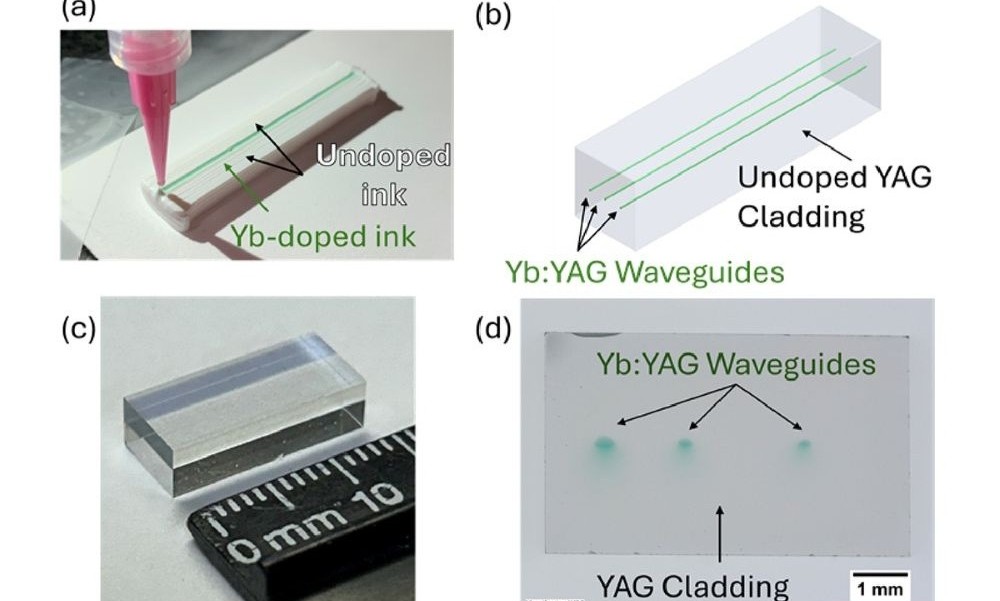
Higher power: LLNL has 3D-printed a transparent ceramic waveguide based on Yb:YAG. Graphic: Osborne et al/Lawrence Livermore National Lab.
Across the world’s seabeds, optical fiber
Waveguiding optics are among the most important advances in photonics since the invention of the laser in 1960. They are fundamental to the structure of glass fiber lasers, which are used for security applications, such as counter-drone laser systems and missile defense.
Now, researchers at California’s Lawrence Livermore National Laboratory (LLNL) have fabricated what they call a “first-of-its-kind” all-
“With further development, this crystalline architecture could enable more than a tenfold increase in output power over glass fibers while retaining a compact footprint,” said LLNL scientist and author Ross Osborne.
Waveguides exploit the phenomenon of total internal reflection with two regions: a core and a cladding material that surrounds that core. As light travels and bounces through the core, it spreads out. When it hits the cladding, it is reflected back into the core.
Ceramics enable higher powers
Typically, waveguides are made from silica glass. A crystalline ceramic version could tolerate higher power output, improve heat dissipation and suppress instabilities. Until now, methods to fabricate such a waveguide were cumbersome and unreliable, often creating very short or poor-quality waveguides.
LLNL’s novel method uses direct ink write printing to address that challenge. The technique squeezes filaments of ytterbium-doped yttrium aluminum garnet within an undoped garnet ceramic matrix.
“We developed a direct ink writing additive-manufacturing technique for fabricating ceramics with highly tailored structures,” said Osborne. “The process begins with a nanoparticle paste that is extruded into a three-dimensional shape. The printed structure is then dried, sintered and hot isostatically pressed to produce a transparent ceramic.”
The team created three waveguides contained in a single ceramic block and demonstrated high-
The channel waveguide lasers described in the paper were tested in collaboration with the DEVCOM Army Research Laboratory in Maryland. The authors continue to refine the process, and they plan to eventually scale the output power from hundreds of milliwatts to kilowatts. Ultimately, they aim to make the waveguide and its production process commercially viable for high-power applications such as laser machining and defense.



Tufts University observes Herpes virus reshaping neurons
August 26 2026