



AI-guided laser carves pyramids to give robots ‘gentler’ grasp
Hong Kong Polytechnic University pairs picosecond laser with neural network to create automated optical sculptor.
16 September 2026
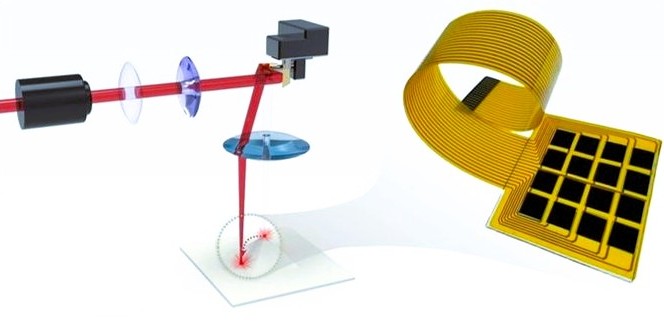
High precision manufacturing of pyramid shaped microstructures for flexible sensors via 3D dynamic focusing laser technology. Credit: Rui Chen et al, HKPU.
While robotic systems have long been deployed in heavy-lifting industrial environments, like car manufacturing plants, their capabilities with delicate manipulation of soft and fragile materials remain largely undeveloped. According to researchers at Hong Kong Polytechnic University, certain robotic systems “routinely crush a soft berry or drop a slippery glass because they cannot feel the delicate boundary between a secure grip and destructive pressure.”
In both surgical robotics and wearable diagnostics, pressure sensors face an enduring dilemma: devices sensitive enough to register a faint arterial pulse usually max out under moderate contact, while sensors built for heavy loads fail to detect gentle touch.
The HKPU team comments, “Crafting rubbery surfaces with microscopic pyramids can resolve this compromise by funneling mechanical forces through sharp tips before spreading across the pyramid walls as pressure increases. However, sculpting these delicate three-dimensional microstructures has long been a manufacturing bottleneck.
“Conventional laser carving operates on a flat plane; as the beam cuts deeper into transparent silicone, the light defocuses and loses intensity, creating jagged steps rather than crisp micro-pyramids.”
Shaping pyramids
To address this bottleneck, Prof. Chunjin Wang’s team at HKPU have paired an ultrafast picosecond laser with a recurrent neural network that acts as an “automated optical sculptor”. They have described their sensitive robot system in the International Journal of Extreme Manufacturing.
Instead of relying on guesswork or exhaustive trial-and-error runs, the algorithm calculates the exact scanning speeds and focal adjustments needed to carve target microstructures within 5% of their intended dimensions. Operating like a high-speed autofocus camera lens synchronized with agile steering mirrors, the optical unit shifts its focal plane downward layer-by-layer as material vaporizes away.
Once the silicone pyramid arrays are carved, the team coats them with an atomized mist of carbon nanoparticles and water-soluble polymer, producing a flexible conductive skin filled with tiny porous channels. The resulting piezoresistive skin bridges extreme sensitivity with a remarkably wide operating window. It registers faint touches down to 5.8 Pa, equivalent to the weight of a single snowflake resting on skin, while maintaining a high linear sensitivity of 104 kPa−1 up to 400 kPa (R2 = 0.996), an upper limit matching the gripping force of heavy industrial machinery.
This performance yields a linear sensing factor (LSF) of 41,600, outperforming conventional square-frustum designs by more than a hundredfold. The device responds in just 21 ms, nearly twice as fast as natural human skin receptors (30 to 50 ms), and sustains over 40,000 compression cycles without physical degradation or baseline drift.
In proof-of-concept trials, a robotic gripper equipped with a single sensor performed closed-loop handling of soft, slippery gelatine cubes (~120 grams), dynamically calculating contact stiffness and fine-tuning its grip in milliseconds to prevent slippage without puncturing the fragile surface. Worn directly on the human wrist, the sensor resolved fine cardiovascular pulse waveforms, including the distinct percussion, tidal, and diastolic peaks, and tracked respiratory cycles across resting and exertion states.
The HKPU announcement concludes: “Translating this laboratory advance into commercial manufacturing will require scaling up dynamic laser ablation for continuous roll-to-roll production lines and ssessing how these micro-structured sensor arrays hold up against twisting shear forces, sweat, and variable environmental humidity over years of daily use.”
U.S. Army Research Office awards $19.2 million to Florida team
October 14 2026
ASML looks to add more capacity as chip boom continues
October 14 2026

UK’s Salience Labs adds $125M series B
October 14 2026

Francis Halzen awarded Nobel Prize in Physics 2026
October 12 2026