



Dissolving microneedles guide light to skin cancers
Texas A&M University helps photodynamic therapy treat tumors more effectively.
22 July 2026
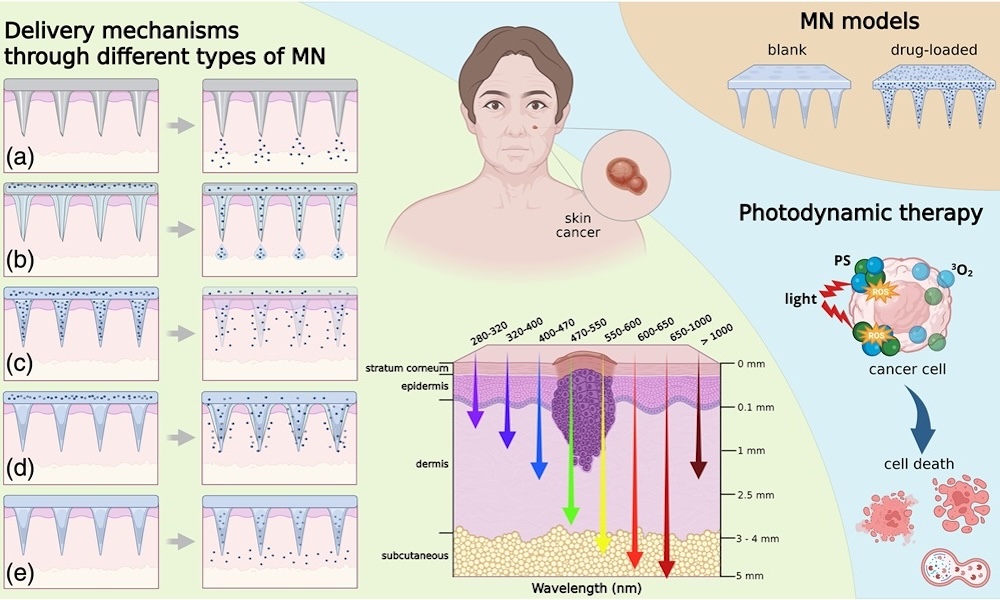
In photodynamic therapy, a light-sensitive drug accumulates in cancer cells and is then activated by light, producing cell-killing molecules. Microneedles can help deliver the drug and distribute light more effectively within non-melanoma skin cancer. Credit: M. Requena/Journal of Biomedical Optics.
Photodynamic therapy (PDT) involves introducing photosensitive drug molecules to the location of a malignancy and then activating them with specific wavelengths of incident light, to create reactive oxygen species that kill the undesirable cells.
The advantage of PDT is the limited damage done to surrounding cells, but it requires both drug molecule and light to reach the same area of tissue. Drugs applied to the skin often struggle to penetrate deeply and light also loses intensity as it passes through tissue, limiting treatment to relatively shallow lesions.
A collaboration between Texas A&M University and Brazil's University of São Paulo has now developed a possible answer to both problems at once. As described in Journal of Biomedical Optics, the team aimed to show that dissolving microneedles, already known for improving drug delivery through the skin, can also be designed to spread light more effectively within tissue.
Microneedles are a valuable tool in PDT, as for example in the LED needle patch designed by CEA-Leti in which needles measuring between 400 and 750 microns in length reach the interface between the skin's epidermis and the dermis, and then deliver 635-nanometer light to tissues of concern.
The new project built on previous work by the Texas A&M and São Paulo group into how microneedles loaded with aminolevulinic acid (ALA), a drug commonly used in PDT, could deliver that treatment more deeply and evenly into skin tumors than traditional creams, so as to bring about more uniform production of the light-activated compound responsible for killing cancer cells.
For this current work the group investigated whether the needles themselves could be modified to improve the delivery of light, through the manufacture of different needle configurations and the use of dissolving microneedles.
More effective and accessible treatments for skin cancer
The researchers fabricated arrays from pyramid-shaped microneedles in different designs, including solid, hollow, dissolving needles, and hydrogel-forming needles that swell on contact with interstitial fluid. When these were illuminated with a green laser, the light emerging from the different arrays was assessed to determine the various exit angles and changes to the light path.
The team also developed a mathematical model to examine how thousands of microneedle tips might distribute light inside tissue, since a broader scattering pattern would reduce the rapid loss of light intensity typically seen with standard directed illumination. This would mean more of the treatment light may reach areas that are difficult to illuminate using conventional approaches.
The findings suggest possible new PDT regimes. One option is to use drug-loaded microneedles first and then apply a second microneedle array designed specifically to improve light delivery. Alternatively a single microneedle system that performs both functions simultaneously could deliver the drug while also guiding and redistributing light.
Either strategy could overcome the current limitations of conventional light-based therapies, noted the team, and support the development of more effective and accessible treatments for skin cancer and other dermatological conditions.
"With more controlled and localized activation, it is possible to minimize adverse reactions such as pain, extensive inflammation, and light hypersensitivity following the procedure," wrote the group in its paper. "Synchronization between the presence of the active photosensitizer and continuous illumination can increase reactive oxygen species production, promoting greater selective damage to tumor cells."
Photodynamic therapy awaits its breakthrough moment
August 15 2013

Upbeat ASML raises 2026 guidance again
July 22 2026