



Entrepreneurs invited to apply for 2027 SPIE Startup Challenge
The competition will bring seven teams head-to-head in pursuit of $10,000 first prize.
17 August 2026
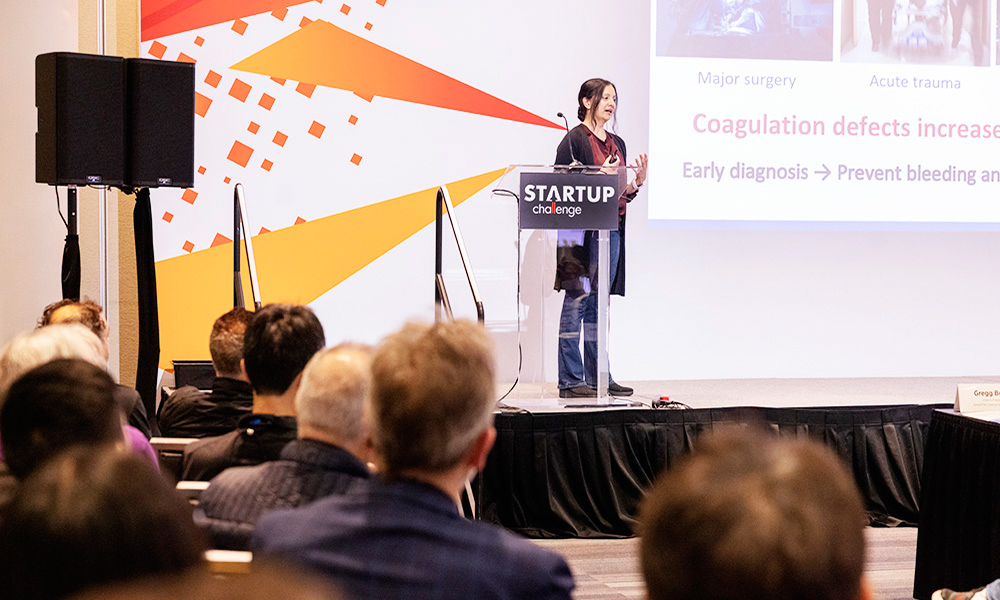
Coalesenz Founder Seemantini Nadkarni pitches her point-of-care coagulation analyzer at Photonics West in January 2026. Photo: SPIE.
Entrepreneurs around the world are invited to apply for a chance to pitch their optics or photonics technologies or products to a panel of expert judges at the 17th annual SPIE Startup Challenge. SPIE, the international society of optics and photonics, holds the competition at Photonics West every January, with multiple teams walking away with cash prizes.
More than a simple pitch competition, the SPIE Startup Challenge is an entry point into the community of high-tech business development of new products in healthcare and deep tech, with an audience of experienced photonics innovators and investors.
Cash prizes of $10,000, $5,000, and $2,500 are provided by Startup Challenge Founding Partner Jenoptik. Also given is the SPIE Jay Kumler Innovation Award, sponsored by Jenoptik, going to the finalist who best exemplifies former President of Jenoptik North America and SPIE Fellow, Jay Kumler’s, commitment to advancing optics and photonics innovation. Participating teams also receive mentoring by industry leaders and gain increased visibility from potential investors.
Previous first prize winners include Max-IR Labs, for facilitating carbon credits with precise CO2 monitoring in water systems, Advanced Optronics, which provides biocompatible integrated photonics for intraoperative monitoring in the cochlea, and Coalesenz, who also won the SPIE Jay Kumler Innovation Award for its hand-held coagulation analyzer.
“Winning first place at the SPIE Startup Challenge and becoming the inaugural recipient of the SPIE Jay Kumler Innovation Award was a defining moment for our team at Coalesenz. The recognition has sparked investor interest, supported new clinical collaborations, and helped us build momentum toward our vision of improving patients’ lives by transforming bleeding and coagulation management at the point of care. We are grateful to SPIE for providing an important platform that helps photonics startups turn innovation into real-world impact,” said Coalesenz Founder Seemantini Nadkarni.
New businesses and potential startups with optics or photonics technology can learn more about the 2027 Startup Challenge, including tips and training from leading experts, by visiting SPIE Startup Challenge. Applications close on 6 October 2026 with finalists being notified on 1 December 2026.
 SPIE launches quantum journal AQP
SPIE, the international society for optics and photonics, has also announced that it is now accepting submissions for Advanced Quantum Photonics (AQP), the scholarly publisher’s newest journal. As the first peer-reviewed journal for applied quantum research, AQP fills a critical gap in the quantum research publishing landscape, enabling collaboration and further advancing this critical field.
Each issue of Advanced Quantum Photonics aims to include contributions from the quantum industry, including implementation and application demonstrations. Submissions from researchers that explicitly address the technological context, implementation challenges, and application pathways of the reported work are also encouraged. Proposals for review articles and perspectives that assess progress, limitations, and opportunities across quantum materials, components, and systems should be sent as proposals to the editor-in-chief of AQP prior to submission.
“We are thrilled to invite the global research community to share their most groundbreaking discoveries in Advanced Quantum Photonics,” said Editor-in-Chief Uriel Levy. “As quantum technologies rapidly transition from foundational physics to practical, real-world applications, this journal provides a dedicated, high-impact platform showcasing the optics and photonics driving this revolution. Publishing with SPIE ensures researchers' work gains exceptional visibility, rigorous peer review, and the trusted global reach of a premier society committed to advancing light-based science."
U.S. Army Research Office awards $19.2 million to Florida team
October 14 2026
ASML looks to add more capacity as chip boom continues
October 14 2026

UK’s Salience Labs adds $125M series B
October 14 2026

Francis Halzen awarded Nobel Prize in Physics 2026
October 12 2026