



EPFL enhances super-resolution imaging from single camera exposures
Polarization-based fluorescence method suits the capture of live cell dynamics.
09 September 2026
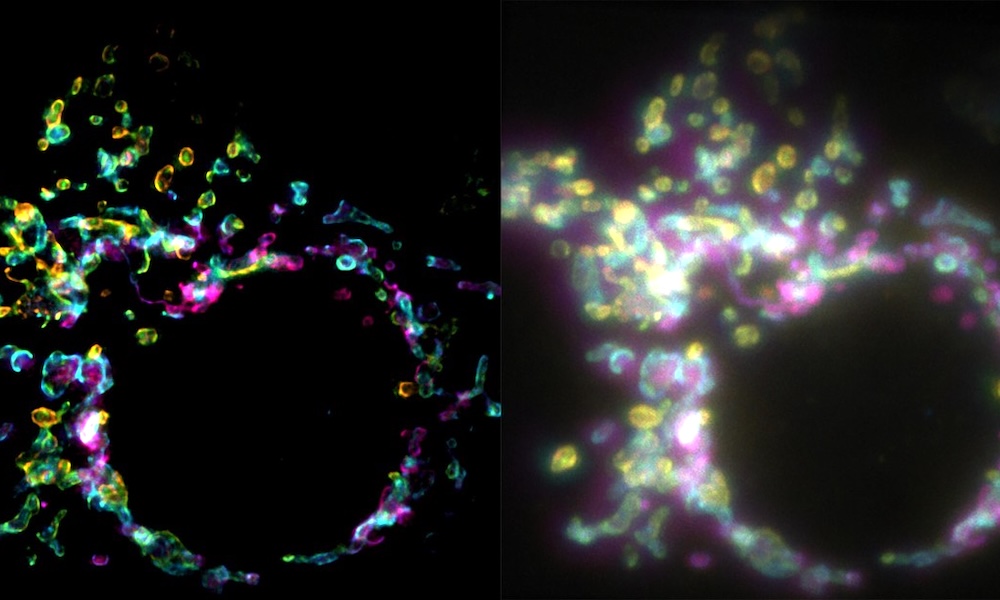
Mitochondrial outer membrane imaged with SPIFFI (left) versus widefield microscopy (right). Credit: EPFL.
Swiss research center EPFL has demonstrated a new modification to super-resolution fluorescence microscopy designed to improve the imaging of live unfixed cells.
Reported in Nature Methods, the technique exploits the inherent properties of polarized detection to achieve an instant improvement in resolution from a single exposure.
"Some methods achieve super-resolution by combining information from hundreds or thousands of image frames taken over time," commented EPFL. "However, this works best when cells or tissues have been fixed, or preserved with chemicals. Otherwise, structures which are constantly moving, changing, and interacting appear blurry using existing super-resolution techniques."
A number of ways to solve the problem have been researched, including use of increasingly advanced fluorescent labels whose emissions can controlled over short time scales. But this approach can be less effective when imaging systems in vivo.
“Essentially, previous approaches used temporal information to resolve spatial resolution, but this doesn’t work very well on living cells,” said Wei Guo from EPFL Laboratory of Nanoscale Biology (LBEN).
The project tackled this hurdle by developing spatial polarization-induced fluorescence fluctuation imaging, or SPIFFI, based around the principle that when fluorescent dipoles are stimulated to emit light, as with the labeling molecules introduced to a specimen in super-resolution fluorescence microscopy, the light emitted is polarized. Hence the light from a molecule oscillates preferentially in certain directions, depending on how the molecule is oriented.
Correlating the fluctuating light from independently emitting fluorescent emitters has been studied previously in super-resolution contexts, but then the approach was based on temporal fluctuations. SPIFFI shifts this into the spatial domain by splitting the fluorescent light into four polarization-sensitive channels, and comparing the resulting images.
Capture rapid nanoscale phenomena as they happen
Use of multiple channels and an effective resampling of the image data enhances the structural detail revealed by the technique, noted EPFL in its paper, alongside the modulations to fluorescence fluctuations brought about by polarization. The inherently smaller size of polarised point spread functions, effectively a more localized point source of fluorescence, also leads to higher resolution data.
In trials EPFL applied the technique to fixed cells and live mitochondria. Results showed that "the method results an image resolution improvement of up to twofold, resolving structures around 160–170 nanometers in size with a single snapshot," said EPFL.
SPIFFI let the team visualize the movements of mitochondria and microtubules, as well as cellular fusion and splitting events which are difficult to image clearly using multi-frame approaches.
"With previous techniques, taking many images would only result in one super-resolved frame," noted Wei Guo. "With SPIFFI, every frame is super-resolved, meaning we can now produce super-resolution videos of live cells. We also seamlessly integrated SPIFFI images with existing fluctuation-based methods for post-processing, achieving resolutions of about 80 nanometers."
The next steps will involve making the SPIFFI imaging setup more compact, and combining the technique with three-dimensional imaging technologies.
"Because the optical hardware can be integrated with existing fluorescence microscopes, SPIFFI could become a practical tool for live-cell biology, neuroscience, biophysics, and drug discovery, allowing researchers to capture rapid nanoscale phenomena as they happen," commented EPFL.
EPFL speeds up protein imaging with single-photon detector
August 13 2025
Trinity College Dublin lights up cellular activity
February 20 2024
U.S. Army Research Office awards $19.2 million to Florida team
October 14 2026
ASML looks to add more capacity as chip boom continues
October 14 2026

UK’s Salience Labs adds $125M series B
October 14 2026

Francis Halzen awarded Nobel Prize in Physics 2026
October 12 2026