


ESA Earth observation mission FLEX set to launch on September 15th…
…and Exail delivers ‘space-grade’ laser source to French Space Agency.
09 September 2026
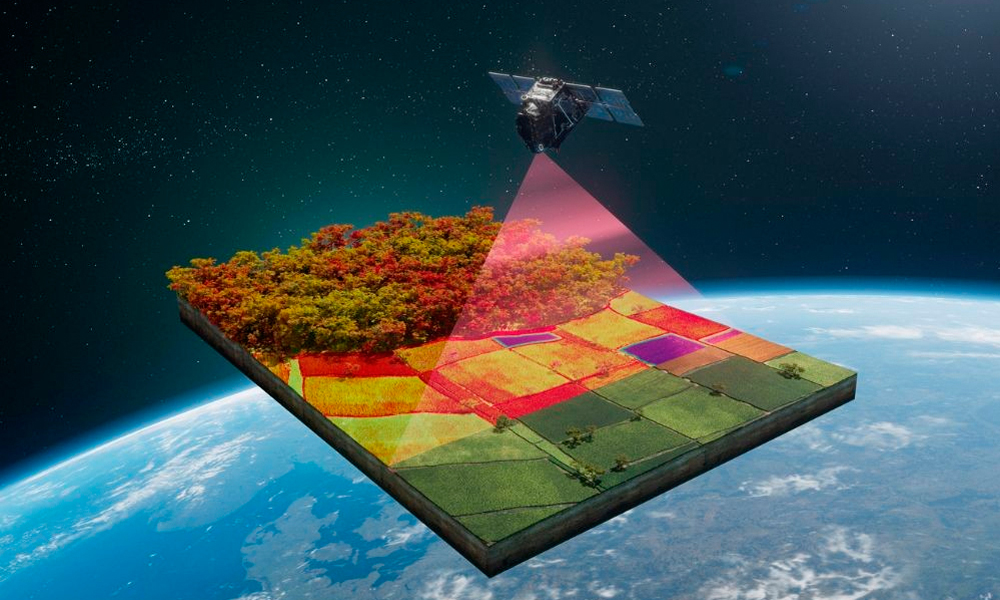
The FLEX mission aims to provide global maps of plant fluorescence. © ESA/ATG medialab.
When the ESA Earth observation mission FLEX launches into space on September 15, 2026 (as scheduled) it will carry high-precision optical components from Jena, Germany. Researchers at the Fraunhofer Institute for Applied Optics and Precision Engineering (IOF) have developed and manufactured a silicon-based double-slit assembly as well as two high-precision mirrors for the spectrometer on board the satellite.
The spectrometer is designed to detect the fluorescence of plants excited by sunlight from Earth’s orbit. The data is expected to provide new insights into the photosynthetic activity, health, and stress levels of vegetation.
ESA’s FLEX mission is designed to answer the questions how much light do plants emit, and what can such light emission tell us about their health? At the heart of the satellite will be the “Fluorescence Imaging Spectrometer,” or FLORIS, for short.
Unlike many other spectrometers, FLORIS operates with two light channels instead of the conventional single channel; one provides particularly high-resolution information on closely adjacent wavelengths, while the second covers a broader range of the light spectrum. This set-up requires an extremely precise dual-slit assembly.
“The fluorescence signals emitted by plants are very weak. For FLORIS to analyze these signals reliably, the optical components must be manufactured and assembled with exceptional precision,” said Dr. Falk Kemper, project manager for the FLEX project at IOF. “The double slit enables a combination of high spectral resolution and broad spectral coverage.”
 Precision in micro- and nanometer range
Each of the two slits in the assembly developed at IOF is exactly 85 µm wide over a length of 44.15 mm, with a tolerance of just 1 µm. Deviations beyond this would result in too much or too little light hitting the detector, thereby impairing the evaluation of the measurement data.
For the manufacturing process, IOF developed a specialized lithographic process chain for silicon wafer structuring. The wafers were masked, patterned, and wet-etched in a time-controlled manner. The slits were then coated with a black layer to achieve the required optical properties and minimize unwanted reflections.
The required precision of the slits in the mechanical holder makes high demands on the assembly process: the sensitive silicon element must be positioned in the holder within a precision of 5 µm, maintaining high parallelism to the apertures. The flatness of the slits must be <10 µm. A combination of form fit, clamping, and bonding ensures that the assembly can withstand the stresses of a rocket launch.
In addition to the double slit, IOF fabricated two mirrors to be integrated into the slit assembly. These direct the incident light onto the spectrometer’s detectors. Their surfaces need to meet a roughness requirement of 0.3 nm rms, which corresponds roughly to the distance between one and two atoms.
 Monitoring plants from space
FLEX stands for “Fluorescence Explorer.” The European Space Agency’s (ESA) mission aims to provide global maps of plant fluorescence. This fluorescence arises during photosynthesis and can serve as an indicator of how actively plants are functioning and whether they are experiencing, for example, drought, heat, or other stress factors. The dual-slit assembly was developed and manufactured at Fraunhofer IOF under subcontract from OHB System AG. The integration of the spectrometer and other preparations for the mission were led by Leonardo S.p.A. and Thales Alenia Space. The mission has been commissioned by ESA.
…and Exail delivers ‘space-grade’ laser source to French Space Agency
 Exail, a Paris, France-headquartered industrial group working in photonics and quantum technologies, and robotics, has announced the delivery of the engineering model of its ultracompact, space-grade laser source to the French Space Agency (CNES) for the CARIOQA-PMP project, Europe’s Quantum Space Gravimetry Pathfinder mission. Commissioning and performance validation of the laser source have been successfully completed at CNES in Toulouse, with no anomalies detected.
Funded by the European Union, the project is preparing a pathfinder mission designed to pave the way for the first in-orbit cold-atom gravimetry demonstration for Earth and climate monitoring. At the heart of the instrument, Exail’s laser will generate the frequency-stabilized laser beams needed to trap, cool and interrogate a cloud of atoms. These atoms act as the test mass in an atom-interferometry accelerometer, enabling extremely precise measurements of gravity-related acceleration. Bringing this capability into orbit requires the close integration of state-of-the-art quantum and space technologies in a compact and robust system.
The laser source is the second engineering-model subsystem delivered for the CARIOQA Pathfinder Mission Preparation (CARIOQA-PMP). Integration with the electrical ground support equipment and the microwave source, delivered by Tetelel and Leonardo, took place during summer 2026, moving the consortium closer to a fully functional ground-based instrument.
“Delivering this laser source is a decisive step in de-risking cold-atom laser technology for space. Our objective is to transfer the metrological stability of our laser systems for terrestrial quantum gravimetry into an architecture that meets the severe size, weight, and power (SWaP) constraints of space. Passing CNES validation demonstrates that we are ready to bridge the gap between quantum physics and operational missions,” said Aurélien Eloy, laser system engineer and CARIOQA-PMP coordinator at Exail.
U.S. Army Research Office awards $19.2 million to Florida team
October 14 2026
ASML looks to add more capacity as chip boom continues
October 14 2026

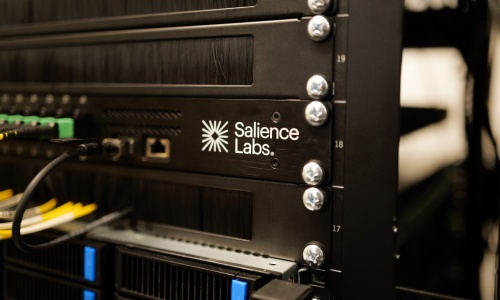
UK’s Salience Labs adds $125M series B
October 14 2026

Francis Halzen awarded Nobel Prize in Physics 2026
October 12 2026