


Fiber optic cable network on Switzerland’s Gorner Glacier reveals structural damage to ice
ETH Zurich project reveals more tell-tale internal crevasses than expected.
19 August 2026
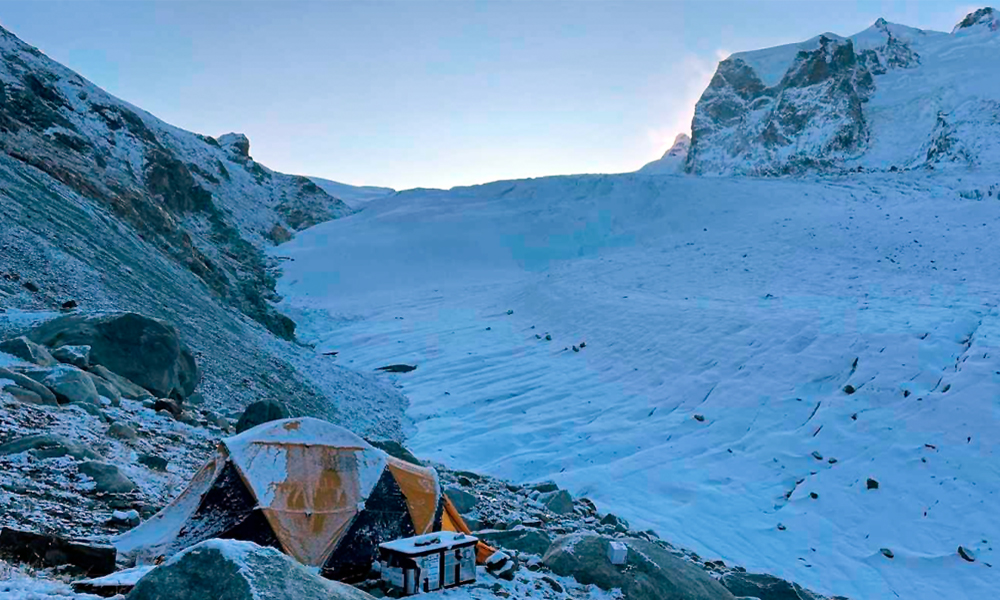
ETH researcher Thomas Hudson camped overnight beside the Gorner Glacier, with Monte Rosa and the Dufourspitze (4,634 m) in the background. Image: Thomas Hudson / ETH Zurich.
In recent years, the European Alps have experienced devastating glacier collapses: in September 2023, a section of the Marmolada glacier in the Dolomites (in Italy) collapsed, resulting in the deaths of seven mountaineers. Just over a year and a half later, in May 2025, the Birch Glacier above Blatten (Switzerland) collapsed, “keeping the country and the entire world on tenterhooks,” stated ETH Zurich.
Crevasses are crucial to the stability of glaciers, not only those that satellites and drones can detect on the surface but also those hidden within the ice. This is because meltwater can deepen them and accelerate the collapse of glaciers and ice sheets.
Researchers use seismic techniques to explore the inner workings of glaciers. Microearthquakes occur when crevasses open within the ice, and seismometers can detect them to pinpoint their sources. However, these measurements lack high spatial resolution, and deploying many seismometers is challenging due to high costs and the difficulty of installing them on a glacier ridden with crevasses.
Replacing measuring instruments
ETH researchers led by Assistant Professor Thomas Hudson from the Environmental and Exploration Geophysics Group have demonstrated in a new study published in Science Advances that this can be done more simply, cost-effectively and with significantly higher spatial resolution. Researchers from the Swiss Federal Institute for Forest, Snow and Landscape Research (WSL) and the University of Oxford were also involved in the study.
For testing, the researchers laid a single fiber-optic cable on the surface of the Gorner Glacier in Valais, south-western Switzerland. This enabled them to explore the glacier’s internal structure down to a depth of 25 meters. “A single fiber-optic cable replaces hundreds of seismometers,” said Hudson.
The cable is connected to what is known as an interrogator, which injects an optical signal into the fiber then records the signals that are reflected back. Seismic waves are generated when a microearthquake occurs, such as a crevasse opening up in the ice. These waves cause a slight local deformation as they hit the fiber, leading to changes in how the injected light is deflected and reflected. This results in a change in the baseline signal, alerting researchers to the location and depth of a crevasse.
 Employing this method on the Gorner Glacier, the wave physicists uncovered a surprisingly large number of hidden crevasses, which accounted for more than eight percent of the ice volume at the measurement site. “That’s far more than we expected,” said Hudson. The crevasses contained water or air, while the rest of the ice – 92 percent – remained undisturbed.
Not all crevasses are visible from the air. Hudson emphasises that they greatly impact the glacier’s stability. “Laypeople often assume that large, visible surface crevasses indicate whether a glacier is stable or not. However, scientists pay more attention to internal cracks and crevasses inside the ice,” he said. Consequently, analysing these internal fractures is essential for researchers when determining whether a glacier is at risk of calving.
The researchers say they could extend their mapping of crevasses to other glaciers in the Alps and the ice sheets of Greenland or Antarctica to better understand their stability. Data collected from within the glaciers could complement satellite surface observations.
Syntec swings to profit as sales climb
August 19 2026

Hesai goes ‘full-stack’ with extended robotics offering
August 19 2026