



goVISCAN measures heart, respiration, oxygen levels non-invasively
Sensor, from Fraunhofer IOF, launched this week at VISION 2026.
09 October 2026
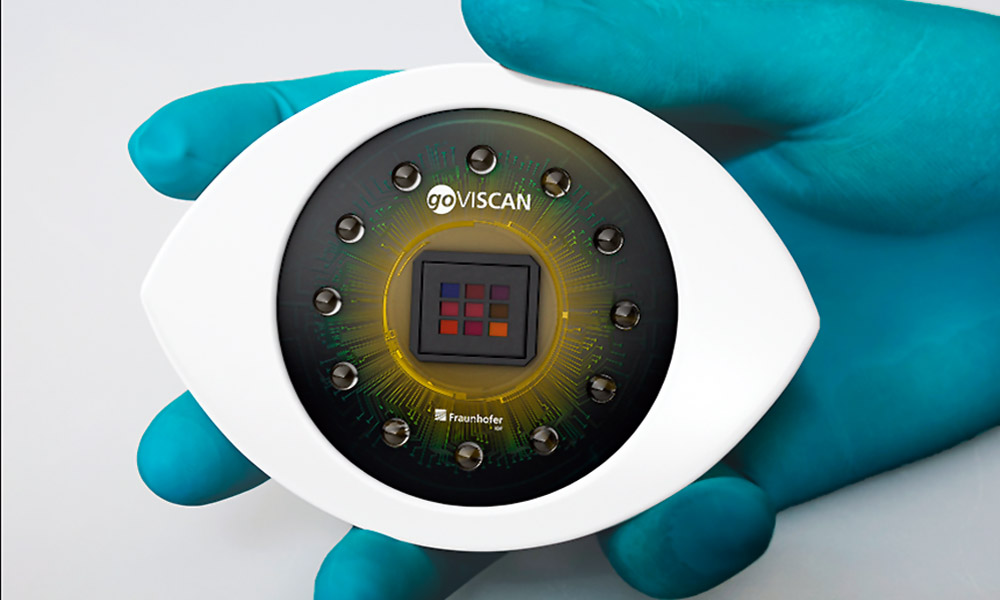
goVISCAN vital sign sensor: the multispectral camera with 3 x 3 micro-lens array captures the spectral bands. LEDs are arranged around it to illuminate the subject. © Fraunhofer IOF.
Measuring heart rate, respiratory rate, and oxygen saturation without electrodes on the skin or invasive sensors on the body. This is enabled by a new, compact sensor called goVISCAN, developed by Fraunhofer IOF and partners in the AMI research alliance. The sensor was this week unveiled for the first time at the VISION trade show in Stuttgart (and at the W3+ trade show in Jena).
Whether in a hospital, a vehicle, or a manufacturing facility: Monitoring a person‘s health without touching them or restricting their freedom to move can be useful in numerous situations. However, conventional measurement methods often require electrodes, cables, or sensors worn on the body. On the one hand, this compromises comfort; on the other, it poses special hygiene challenges, particularly in healthcare and nursing applications.
Researchers at IOF have been working for many years on solutions to measure key vital signs completely contactless and solely through optical measurement. And they have been successful: Earlier systems developed by the institute were already capable of measuring heart rate, respiratory rate, and oxygen saturation contactlessly, but these were bulkier and more complex to build and use.
“Many existing camera-based methods work under ideal conditions only,” said Martin Hubold, a researcher at IOF. “As soon as the measurement scene is not optimally illuminated or the person being measured moves, the weak physiological signals are quickly overlaid by perturbations.”
The AMI research consortium says that goVISCAN significantly reduces these limitations. The consortium, which received funding through the “Regional Entrepreneurial Alliances for Innovation” (RUBIN) program, focused on a particularly compact design: goVISCAN is sized just 10 × 7.5 × 2.5 cm. At the same time, the sensor is designed to enable reliable measurements even under varying lighting conditions and when the subject is moving. “Our goal was to create a sensor that measures reliably even under realistic conditions—and is compact enough to be discreetly integrated into everyday environments,” said Hubold.
Nine spectral channels
The core technology of the goVISCAN vital sign sensor is a novel multispectral camera. It consists of a high-precision arrangement of nine micro-lenses; a so-called micro-lens array. Although this micro-lens array is monolithic, meaning that it is made from a single piece of glass, each lens is optimized for a specific wavelength range—from blue over green and red to the near-infrared range, which is invisible to the human eye.
“This means that each micro-lens works like a single objective and generates its own image,” said Hubold, who led the development of the system design. Each lens maps the scene onto its individual section of a shared image sensor with a resolution of 1.25 megapixels and an f/4 aperture.
“Combining the image information from the various spectral channels makes the system particularly powerful and versatile,” he said. This combination enables goVISCAN to detect even weak fluctuations in skin brightness, such as those caused by pulsating blood flow within the skin.
goVISCAN currently covers a 40-degree field of view and operates at distances ranging from 70 centimeters to 1.3 meters from the person being analyzed. A potential application is obviously the field of healthcare and nursing, for example, to monitor patients in hospital beds as well as future uses in telemedicine, where doctors are connected digitally. Other potential use cases are driver monitoring in automotive applications to detect fatigue and monitor alertness or in control rooms where attention and stress levels play a significant role.
In an initial pilot study, the researchers tested the new goVISCAN sensor with twelve participants under controlled laboratory conditions. “The study demonstrates the technology’s potential,” Hubold concludes. “Compared to the finger pulse oximeter as a reference system, the mean error was 1.3 breaths per minute for respiratory rate, 2.8 beats per minute for heart rate, and 3.8 percentage points for oxygen saturation.” The next step is now to test the system in a clinical setting.
Related publication
Martin Hubold, Johanna Karl, Kevin Srokos, et al described the development of goVISCAN in the paper Contactless vital sign parameter measurement using compact snapshot multispectral multiaperture camera: design, realization, application, evaluation, Proc. SPIE 14111, Optical Instrument Science, Technology, and Applications IV, 1411103 (May 28, 2026).

U.S. Army Research Office awards $19.2 million to Florida team
October 14 2026

ASML looks to add more capacity as chip boom continues
October 14 2026

UK’s Salience Labs adds $125M series B
October 14 2026

Francis Halzen awarded Nobel Prize in Physics 2026
October 12 2026