



Hesai goes ‘full-stack’ with extended robotics offering
Chinese lidar firm adds spatial intelligence and robotic actuation to its technology portfolio.
19 August 2026

Hesai Technology, the Shanghai-headquartered market leader in automotive lidar, has detailed plans to extend its technological scope dramatically, in a bid to target the emerging market for humanoid robotics.
While the Nasdaq-listed company’s current business remains dominated by lidar shipments now approaching 3 million units per year, CEO David Li told an investor conference call discussing Hesai’s latest financial results that the firm had passed a defining milestone as it evolved to provide a “full-stack infrastructure platform” for robotics and physical AI.
Those results showed that shipments of close to 630,000 lidar units in the June quarter delivered sales revenues equivalent to $127 million, with Hesai able to post a net income of $10.4 million - all up sharply on the same period last year.
Regulatory effects
With stricter safety regulations for autonomous vehicles coming into effect in China next year and robotic applications accelerating, those shipment numbers are expected to keep growing quickly, with Li and his team expecting to ship at least 3 million units in 2026 overall.
“A modern intelligent car is arguably the most widely deployed robot on Earth, and the industry has moved beyond the question of can the car drive itself,” the CEO said. “The question now is whether it can do it safely every single time with backup when something fails. That is a completely different bar.”
Li pointed out that mandatory Chinese regulations for Level 3 and Level 4 autonomy will take effect next year, while proposed US legislation could require autonomous vehicles to run two independent sensing technologies beyond cameras - with lidar and radar the obvious options.
“Lidar is the invisible airbag,” Li told investors, pointing to Li Auto’s new mid-range “L6” model offering four lidars as an option. “Four lidars at a mainstream price point. That is the moment an advanced feature goes mass-market, and that is how content per vehicle compounds.”
Full-stack move underway
However, Li and Hesai are now looking to capture a much larger market share in the robotics sector, building on the firm’s existing presence as a key provider of lidar sensors with the addition of spatial intelligence and robotic actuation modules.
“That same demand for high-performance 3D sensing [in vehicles] is expanding rapidly into humanoids and other intelligent machines,” the CEO said. “Morgan Stanley estimates that robots could deploy roughly six times as many lidar sensors as automotive by 2050.
“You can only drive one car at a time, but in the future, you might interact with many different robots in a day.”
Initial prototypes of Hesai’s “Kosmo” spatial intelligence platform - which combines an AI spatial camera with algorithms, 3D spatial assets, and cloud services - have already shipped, while actuation modules are being supplied to humanoid robotics specialist Sharpa, a startup co-founded by Li.
“Our [actuator] production line is fully operational, with shipments underway for dextrous hands and full-body joints ramping soon,” said the CEO. “By empowering them to see, understand and act in a closed loop, Hesai is entering an exciting new chapter of growth - building the foundational infrastructure for a future shaped by robotics and physical AI.”

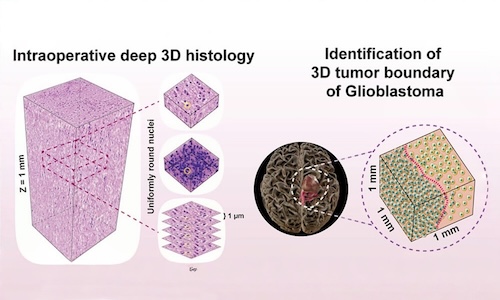
Fudan University images tumor boundaries within 30 minutes
August 18 2026