


HKUST improves imaging of brain activity to help diagnose disease...
...while Cerca Magnetics receives £3.8 million for wearable brain scanner.
28 April 2026
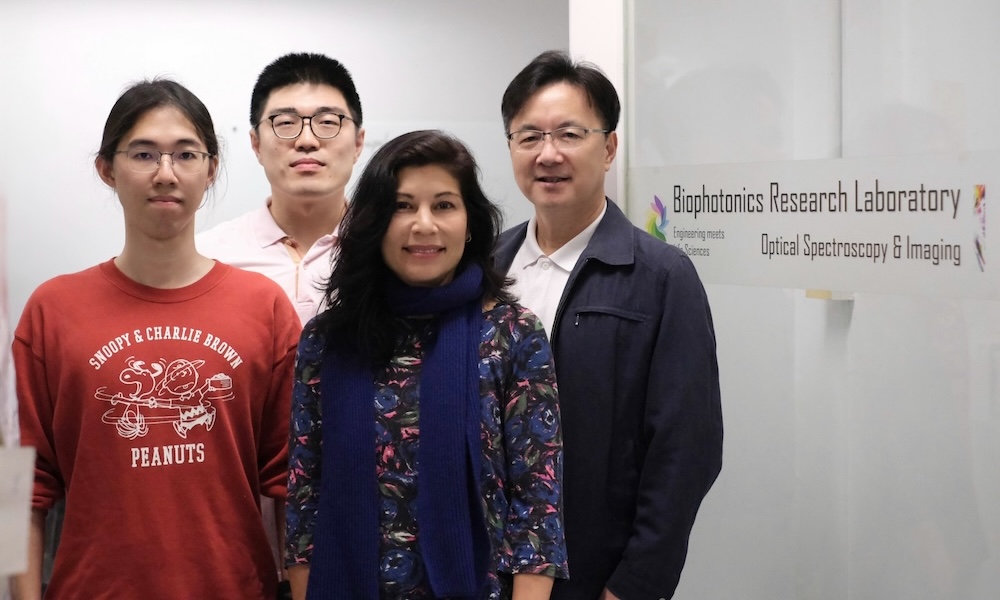
The HKUST research team includes co-corresponding authors Prof. Qu Jianan (right, back row) and Prof. Julie L. Semmelhack (right, front row), together with co-first authors Mr. Yan Gewei (left, back row) and Dr. Tian Guangnan (right, front row). Credit: HKUST.
A project led by the Hong Kong University of Science and Technology (HKUST) has developed a laser-based technique to improve the precision of all-optical brain manipulation and imaging.
The findings, published in Nature Communications, address a recognized hurdle for high-resolution two-photon stimulation and imaging of neural activity: unintended excitation of light-gated ion channels such as channelrhodopsin (ChR) which contaminates neural activity measurements.
"All-optical approaches hold great promise, but crosstalk has been a major barrier,” said Qu Jianan from HKUST. "When you use microscopic imaging to observe neural circuits, the imaging light secretly pushes them around, influencing the operation of neurons and even the entire neural circuit."
The HKUST solution is termed active pixel power control (APPC). A fast acousto-optic modulator guided by custom mapping software dynamically adjusts laser power for each scanning pixel, according to the team's published paper. This delivers reduced or even zero power to specific neurons with varying levels of optogenetic protein expression, while maintaining uniform and stable light intensity across other brain regions, reducing the issue of crosstalk.
"Synchronized with resonant scanning, the acousto-optic modulator dynamically adjusted power in real time, minimizing unintended channelrhodopsin activation while maintaining calcium signals," wrote the project.
In trials on larval zebrafish APPC successfully preserved the signal quality of neuronal signals while suppressing optogenetic artifacts and reducing crosstalk. The same principle could be readily extended to other animal models, according to HKUST, particularly to mice as the most commonly used model in modern neuroscience.
"All-optical interrogation enables researchers to precisely investigate how brain circuits drive behavior under natural physiological conditions," said Qu Jianan. "Now APPC brings that vision closer by solving the crosstalk issue, one of the biggest technical roadblocks."
Enabling brain imaging in infants
Elsewhere in neural imaging research, the UK's Cerca Magnetics has secured £3.8 million in Series A funding for development of a wearable brain scanner using quantum sensors to measure neural activity with high precision.
Cerca, a spin-out from the University of Nottingham, intends its technology to allow lightweight wearable sensors worn by patients moving naturally during scans, and enabling brain imaging in infants for the first time. This has the potential to significantly improve the accessibility of brain imaging, particularly for children.
According to Cerca product data, the company's brain imaging platform is based on optically-pumped magnetometers (OPM) capable of detecting very small magnetic fields, but without the complex cryogenic cooling required by traditional OPMs.
Cerca envisages magnetoencephalography with optically pumped magnetometers, or OPM-MEG, in which the magnetic fields generated by current flow in neural assemblies are detected as an assessment of brain function in health and disease, but using simpler and more cost-effective instrumental platforms than are currently employed.
The new funding will support clinical approval, manufacturing scale-up and international expansion, commented Cerca Magnetics, which indicated that it has sold 19 systems to neuroscience centres across twelve countries. The technology is currently being applied to conditions including epilepsy, multiple sclerosis, and dementia, with clinical approval pathways underway in the UK and the United States.
"This investment enables us to move decisively into clinical applications, scaling our technology for routine use in hospitals in the UK and internationally," commented Cerca CEO and co-founder David Woolger. "Our goal is to make advanced brain imaging more accessible, supporting earlier diagnosis and better treatment of neurological conditions."
HKUST images mouse cortex at 'unprecedented depth'
June 21 2022
HKUST develops smallest multifunctional biomedical imaging robot
January 22 2025

Laser weapons and battery welding aid IPG Photonics sales growth
November 04 2026
Rockefeller University microscope points to deeper brain imaging
November 04 2026

Europe-Japan group to industrialize flexible perovskite solar cells
November 03 2026