


Hollow-core fiber platform helps quantum technologies exchange information
UCLA, SLAC, Rochester, and Ottawa investigated if four-wave mixing preserves quantum light’s phase.
25 August 2026
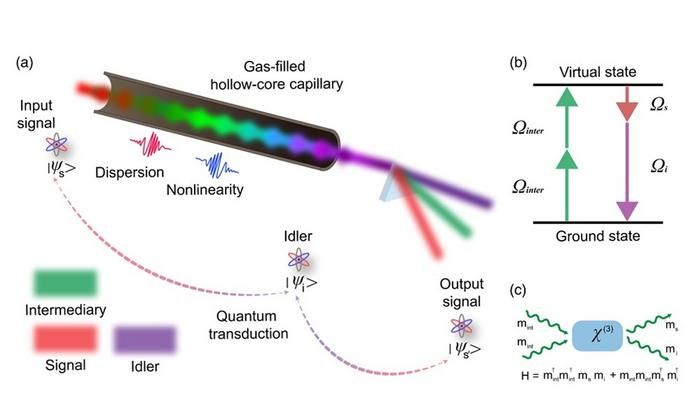
Hollow-core waveguide enables efficient four-wave mixing by guiding light through a gas-filled core. Credit: H. Zhang et al.
Quantum technologies promise secure communication networks, powerful forms of computing, and new sensing tools. One of the major challenges, however, is that different quantum systems often operate at different wavelengths of light.
Quantum memories, trapped ions, and other quantum devices may work best in the ultraviolet or visible range, while long-distance communication over optical fibers works most efficiently at telecommunications wavelengths.
Building practical quantum networks will require reliable ways to translate quantum information between these different optical bands without losing the information carried by the light.
A new study, published in Advanced Photonics Nexus, explores a promising route to achieving that goal through a process known as four-wave mixing (FWM).
The research team — from UCLA, SLAC National Accelerator Laboratory, the Universityof Rochester, and the University of Ottawa — investigated whether FWM can preserve one of the most important properties of a quantum light signal: its phase. If a wavelength-conversion process alters this phase unpredictably, information can be degraded or lost. Demonstrating phase-preserving conversion is therefore a key step toward creating interfaces that allow different quantum technologies to work together.
Hollow core
To study this problem, the team modeled frequency conversion in a gas-filled hollow-core capillary fiber, a hollow optical waveguide filled with xenon gas. In their scheme, an input light signal interacts with a strong intermediary laser pulse inside the fiber, generating a new output wavelength through four-wave mixing.
The researchers examined three conversion scenarios chosen for their relevance to future quantum technologies: converting infrared light at 1030 nm to ultraviolet light at 343 nm, converting telecommunications-band light at 1550 nm to ultraviolet light at 308 nm, and converting telecommunications-band light at 1550 nm to visible light at 516 nm.
These wavelength combinations could help link fiber-based communication networks with systems such as optical clocks, trapped-ion quantum devices, Rydberg-atom platforms, and rare-earth quantum memories.
Rather than focusing only on conversion efficiency, the team analyzed how faithfully phase information was transferred from the input signal to the newly generated output light. They simulated different types of phase structures, including linear phase patterns and two forms of quadratic phase modulation that change how a pulse evolves in time.
By comparing the phases of the input and output signals, they calculated correlation values that indicate how accurately phase information is preserved during conversion.
‘Strong phase preservation’
The simulations revealed strong phase preservation across a wide range of operating conditions. In many cases, correlations between input and output phase profiles exceeded 0.95, and under favorable conditions rose above 0.99. The highest phase fidelity generally occurred when the intermediary laser pulse had relatively low energy and narrow bandwidth. Under those conditions, the wavelength-conversion process transferred phase information with very little distortion.
The study also showed that performance depends strongly on the conversion pathway. The telecommunications-to-visible conversion, which translated 1550 nm light into 516 nm light, proved especially robust.
High phase correlations remained across much of the tested parameter range, suggesting that this wavelength pairing may offer an attractive balance between efficiency and coherence. In contrast, telecommunications-to-
The researchers identified the source of these limitations. As laser energies grow, nonlinear effects within the fiber become stronger. These effects can broaden the spectrum of the light and reshape its phase, reducing the accuracy of the wavelength translation. The findings highlight an important tradeoff: conditions that improve conversion efficiency can also increase phase distortion. Successful quantum transducers will therefore need to balance efficiency and coherence rather than optimizing only one metric.
The team also analyzed conversion efficiency. For infrared-to-ultraviolet conversion, efficiencies reached as high as 28 percent under linear phase conditions. Telecommunications-to-
Although the work was conducted through modeling rather than direct quantum-state measurements, the results suggest that gas-filled hollow-core fibers could provide a practical platform for connecting quantum technologies that operate at widely separated wavelengths. The ability to preserve phase information during frequency conversion is particularly important because it underpins quantum coherence, a requirement for transmitting and processing quantum information.
“These findings lay the groundwork for integrating heterogeneous quantum platforms across widely separated optical bands,” said Hao Zhang, corresponding author for the report. Zhang noted that future experiments will need to test whether the same phase-preserving behavior


Tufts University observes Herpes virus reshaping neurons
August 26 2026