


Jilin University turns leather into wearable power source
Laser-scribed conductive patterns on leather surface act as microcapacitors.
09 April 2026
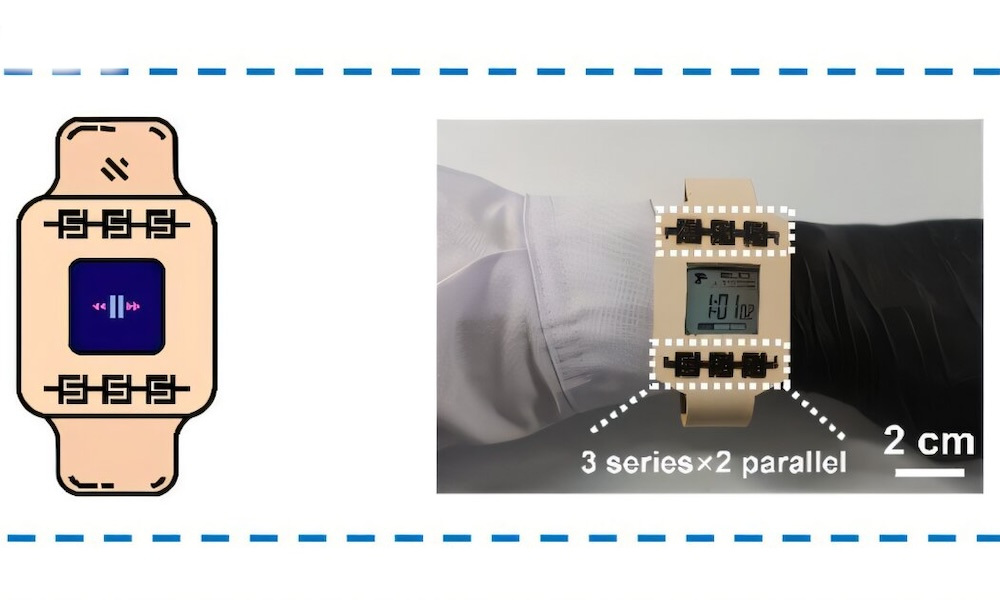
Microsupercapacitors powering an electronic watch. Credit: Jilin University.
A project at China's Jilin University has demonstrated a method for turning natural leather into a flexible wearable energy source.
Published in Optics Letters the findings could lead to wearable electronics manufactured in ways that are more sustainable than current approaches.
In particular the study offers a route to supercapacitors (SCs), a form of energy storage device capable of managing high power density compared to batteries and critical to the development of efficient wearable electronics. Carbonized surface structures are a key part of SC manufacture.
"Sustainable electronics are environmentally friendly," wrote the project in its paper. "However, it is a crucial challenge to fabricate sustainable microsupercapacitors (MSCs) that can be integrated with wearable electronics with high fabrication precision."
The new study built on previous Jilin University research into laser fabrication of microdevices on complex surfaces, when the project realized that a similar laser technique could also be applied to everyday materials to address the different challenge of wearable electronics.
A process was developed in which a CO2 laser writes patterns into the surface of vegetable-tanned leather, a natural material processed using plant-based extracts. The laser converts the leather surface into conductive carbon in a single step through direct carbonization, and by tuning the laser parameters the researchers can control the carbon properties without any complex fabrication steps.
The conductive patterns then serve as electrodes that allow positive and negative ions to gather on the electrode surfaces during charging and release it quickly when needed, so the device can store energy and smooth out electrical signals to keep electronics running steadily.
Customized designs without losing functionality
"Our method replaces plastic substrates with a renewable material, simplifies fabrication into a single laser step without chemicals or cleanroom processes, and combines energy storage with signal filtering in one device," said Dong-Dong Han from Jilin University. "While some approaches may achieve higher performance in specific metrics, they often come with greater complexity or environmental cost."
In trials the project's conductive patterns maintained stable performance over many charge-discharge cycles and worked well at the standard 60 Hz frequency used in everyday electronics.
As a practical test the project used its MSCs to power LEDs and an electronic watch, and also created patterned MSCs in the shapes of tigers, dragons and rabbits to demonstrate how customized designs can be created without losing functionality.
The next steps will include refining the MSCs to improve performance, durability and filtering, aiming for behavior closer to an ideal capacitor at everyday frequencies, according to the project.
The laser process and materials will also be fine-tuned to ensure long-term stability under conditions like sweat, humidity and repeated bending, while also working toward integrating the devices into wearable systems such as self-powered health-monitoring patches.
“The microsupercapacitors are well-suited for flexible and comfortable wearable electronics because they are built on soft materials and can be shaped freely and integrated directly into products,” said Han. “For example, a smartwatch band could store and regulate power instead of relying on a rigid battery, making the device thinner and more comfortable. The technology could also be used in skin-mounted sensors, smart clothing or other everyday accessories that power small electronics.”
Penn State wearable sensor tracks temperature and strain
February 12 2025

Leica and Cognex launch AI software module Aivaro to improve inspection
September 30 2026

Photonic monitoring to identify food safety, quality, and animal welfare
September 30 2026
Advances in optics and computation boost coronary intravascular imaging
September 30 2026
Australia’s SKA tests antenna layout for Low telescope
September 30 2026