



Karlsruhe develops hybrid energy system for electricity, heating and cooling
Passive Daytime Radiative Cooling concept could suit energy intensive applications such as AI data centers.
18 August 2026
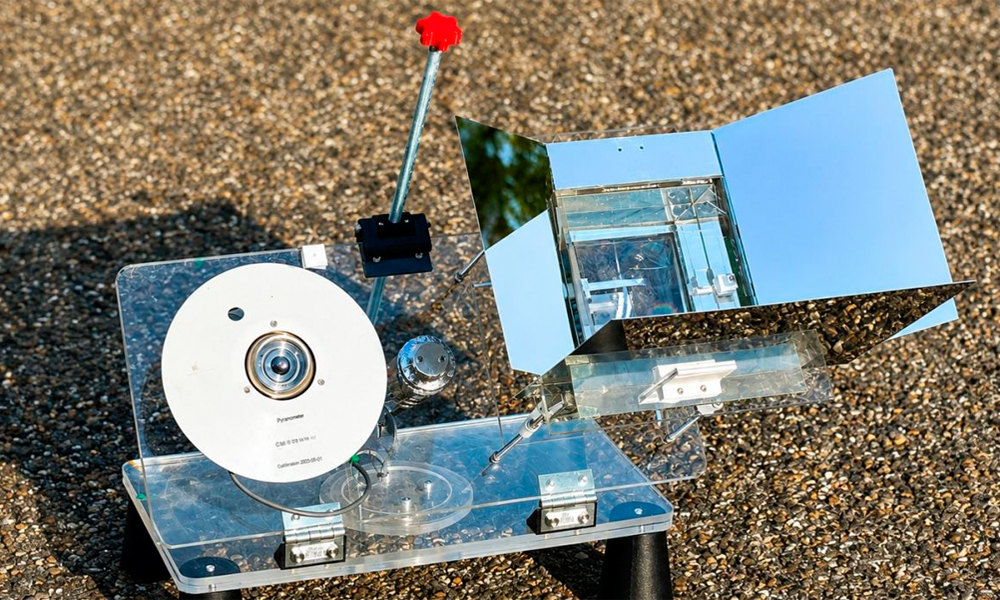
Prototype of the hybrid sun–universe energy harvester for the simultaneous generation of electricity, heating, and cooling. Photo: Gan Huang, KIT.
Buildings today typically rely on separate systems to provide electricity, heating and cooling. A research team at the Karlsruhe Institute of Technology (KIT), Germany, has developed a hybrid energy system that delivers all three simultaneously from the same surface by combining solar energy with the coldness of outer space.
At the heart of the system is a transparent cooling layer that radiates heat into outer space as infrared radiation while allowing sunlight to pass through. The researchers successfully demonstrated the concept with a prototype under outdoor conditions and see it as a potential building block for multifunctional building envelopes. The achievement is described in Cell Reports Physical Science.
Photovoltaic panels generate electricity, solar thermal collectors provide heat, while cooling is usually supplied by air-conditioning systems that themselves consume electricity. As a result, buildings require different technologies competing for the limited space available on roofs and facades.
Cooling, electricity, and heating from one surface
The solution developed by a team led by Dr Gan Huang at KIT’s Institute of Microstructure Technology, by contrast, simultaneously provides cooling, electricity and heating from a single surface. This hybrid PDRC-solar system combines photovoltaics, solar thermal, with passive daytime radiative cooling (PDRC).
The researchers see applications wherever cooling and energy are required simultaneously. “Our vision is that roofs and facades could become active energy surfaces that simultaneously provide electricity, heating and cooling,” said Huang. “The concept could also be attractive for energy-intensive applications such as AI data centres which need intensive power and also cooling.”
At the heart of the system is a transparent emitter consisting of a silica substrate coated with the silicone polymer polydimethylsiloxane. The layer allows sunlight to pass through while simultaneously emitting heat as infrared radiation through the atmospheric window – the wavelength range in which the Earth's atmosphere is highly transparent to thermal radiation. Beneath the transparent emitter, a Fresnel lens concentrates the transmitted sunlight onto a compact photovoltaic-thermal collector, where electricity and heat are generated.
During outdoor experiments, the prototype simultaneously achieved cooling of up to 6.5 °C below ambient temperature, an electrical power density of 60.6 W/m², and heating temperatures of up to 110.8 °C.
“We demonstrate that a single system can simultaneously harvest the hot sun and the cold universe,” said Huang, who heads the Hybrid Solar Technologies Lab at KIT.
The greatest challenge was to combine two fundamentally opposing processes. “We are bringing together fire and ice,” said Huang. “While the solar collector should absorb as much solar energy as possible, the radiative cooler must remain as cool as possible.”
Separating hot and cold layers
“We solved this problem by allowing sunlight to pass through the transparent cooling layer first. Beneath it, a Fresnel lens concentrates the light onto a much smaller solar collector. This keeps the hot solar collector physically separated from the cooling layer,” said Iván Alberto Cruz García from KIT’s Institute of Microstructure Technology, doctoral researcher and first author of the study.
The study builds on the team’s previous work. In 2024, the researchers introduced a transparent material that passively cools buildings while transmitting daylight. Building on this concept, the team has now integrated radiative cooling with a solar energy harvesting component.
“Based on this work, we have now combined radiative cooling with solar energy harvesting. This transforms a single surface into a multifunctional energy system,” said Huang. The next steps include improving the optical design, thermal management and solar cells.
For Huang, the study – carried out in collaboration with Professor Shanhui Fan of Stanford University, a leading expert in PDRC – represents a shift in perspective: "The sun is not the only energy resource in the sky. The coldness of outer space is another renewable resource. If we learn to harvest both the hot sun and the cold universe together, we can unlock a new generation of energy systems.”


Fudan University images tumor boundaries within 30 minutes
August 18 2026