


Mojo Vision gains $24.4 M in Government funding to advance its micro-LED platform...
…and Maryland to lead $7.5 M defense project into shaping laser light to control matter.
28 October 2026
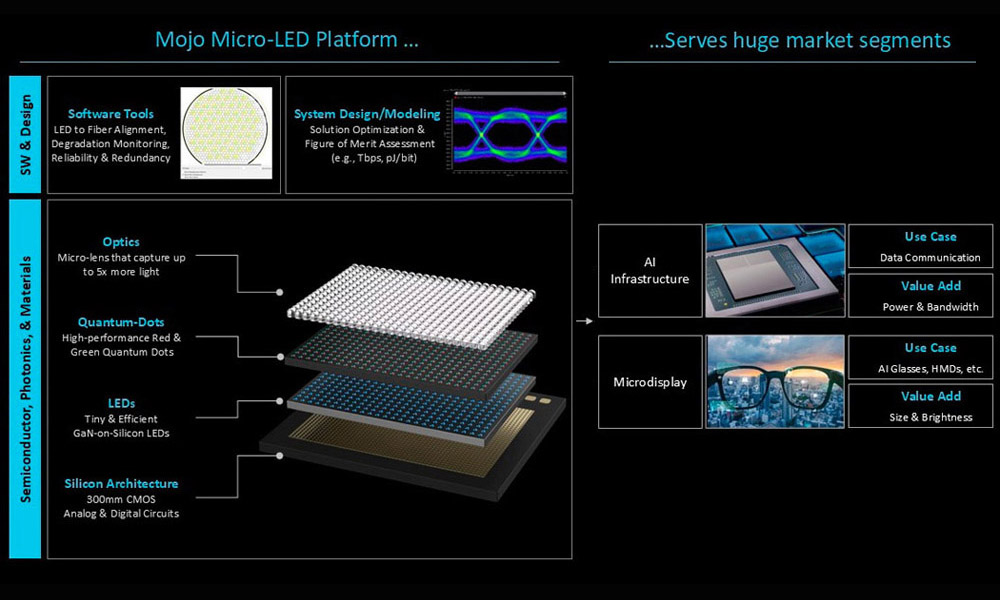
Mojo Vision’s Micro-LED Platform. The defense display program is intended to strengthen U.S. manufacturing and micro-LED technology. Graphic: Mojo Vision.
Mojo Vision , a U.S.-headquartered developer of a flexible, wafers-in, wafers-out micro-LED platform, has announced $24.4 million in additional funding under an Other Transaction Authority agreement. The funding is through the U.S. Office of the Assistant Secretary of War for Industrial Base Policy, with $20 million coming from its Industrial Base Analysis and Sustainment (IBAS) program and $4.4 million from U.S. Army Command, Control, Communications, Computers, Cyber, Intelligence, Surveillance, and Reconnaissance (C5ISR).
This investment is Mojo’s largest government award to date, and will be used to strengthen the defense industrial base, boost domestic manufacturing and advance its micro-LED platform through the development of monolithic full-color microdisplays for near-eye augmented reality applications.
The program will develop ultra-bright, monolithic microdisplays using Mojo’s proprietary quantum dot color conversion system.
The displays are designed to improve brightness and reliability while reducing size, weight and power – giving warfighters more comfortable equipment and better situational awareness. Advances in the underlying micro-LED technology, CMOS integration, and wafer scale manufacturing are also expected to strengthen the shared platform behind Mojo’s display and optical interconnect businesses.
“This award accelerates our work to put ultra-bright, full-color displays into the hands of the warfighter and strengthen America’s ability to manufacture them,” commented Nikhil Balram, CEO of Mojo Vision. “This program strengthens the technology and manufacturing foundation behind both.”
The U.S. Department of War previously underscored the importance of a secure domestic supply: “Microdisplays are crucial components in delivering information to the joint warfighter and are integrated into solutions across all domains including heads-up-displays for pilots, advanced night vision goggles, weapon optics, and unmanned systems,” said Michael Cadenazzi , U.S. Assistant Secretary of War for Industrial Base Policy. “Securing a domestic supply of advanced MicroLED displays is vital for the Department’s next-generation defense applications, ensuring both performance and security.”
Maryland to lead $7.5 M defense research project into shaping laser light
A University of Maryland–led team has won a U.S. Department of Defense $7.5M 2026 Multidisciplinary University Research Initiative (MURI) award to investigate how shaping intense laser pulses in space and time can open new ways to control matter.
Led by Distinguished University Professor Howard Milchberg and supported through the Air Force Office of Scientific Research, the project brings together researchers from six universities with expertise spanning laser physics, nonlinear optics, plasma science, and the generation and control of structured light.
The team will work with pulses lasting only femtoseconds. Within these brief flashes, researchers can determine where the light is strongest, how its waves line up and the direction in which its electric field oscillates. Such “structured light” gives them new ways to direct the forces that laser pulses exert on electrons and other charged particles.
At high intensity, the interaction becomes a two-way process: light changes the material it passes through, and the altered material reshapes the light. Understanding and controlling that exchange is central to the project, titled “Physics and Applications of Intense, Spatiotemporally Structured Light Fields.”
 Different forms of structured light
The team will explore several forms of structured light. Spatiotemporal optical vortices contain a circulation of optical phase in space and time and can form smoke-ring-like structures that govern energy flow within a pulse. In “flying focus” pulses, the point of highest intensity follows a chosen trajectory. Other pulses carry a twist around their direction of travel or have electric fields whose orientation varies across the beam. Each offers a different way to control how light transfers energy and momentum to matter.
One goal is to improve compact particle accelerators. Intense laser pulses can drive powerful electric fields in plasma, a gas of free electrons and ions, and accelerate particles over much shorter distances than conventional accelerator technology. The team will investigate how structured pulses can improve electron and ion beams, tailoring their energy, direction and spatial distribution. Experiments will also examine how these interactions can produce enhanced neutron sources, with potential uses in imaging and materials analysis.
The project will also explore new sources of radiation and strong magnetic fields. Shaping the driving laser pulses could allow researchers to control the structure of extreme-ultraviolet light, generate intense radiofrequency and terahertz pulses, and drive electric currents that produce powerful magnetic fields. These studies could expand the tools available for probing matter and investigating its behavior under extreme conditions.
‘Atmospheric optical structures’
Another goal is to use light to create temporary optical structures in the atmosphere. Carefully arranged laser pulses can heat air to form channels that guide a subsequent beam, much as an optical fiber guides light. The researchers will explore how to extend and sustain these air waveguides, and how arrays of laser-generated plasma filaments might steer microwave and terahertz radiation. Such capabilities could eventually support remote sensing, communications and energy delivery.
To make these experiments possible, the team will develop optical components that shape powerful pulses while resisting laser damage. These include spiral mirrors that impart a twist to light, optics that control the electric field’s orientation, and dielectric metasurfaces: surfaces patterned with features smaller than a wavelength of light that can combine several beam-shaping functions in a compact element. Experiments at advanced laser facilities will be closely linked with theory and computer simulations to understand how the shaped pulses evolve and interact with matter.
Milchberg holds joint appointments in UMD’s Department of Physics, Department of Electrical and Computer Engineering, and Institute for Research in Electronics and Applied Physics. He leads the Laboratory for Intense Laser-Matter Interactions, a member of the LaserNetUS network.

Laser weapons and battery welding aid IPG Photonics sales growth
November 04 2026
Rockefeller University microscope points to deeper brain imaging
November 04 2026

Europe-Japan group to industrialize flexible perovskite solar cells
November 03 2026