



Photonics21 welcomes Chips Act 2.0 inclusion of photonics
Platform calls for a dedicated European Photonics Partnership; plus Board of Stakeholders election set for this fall.
22 July 2026
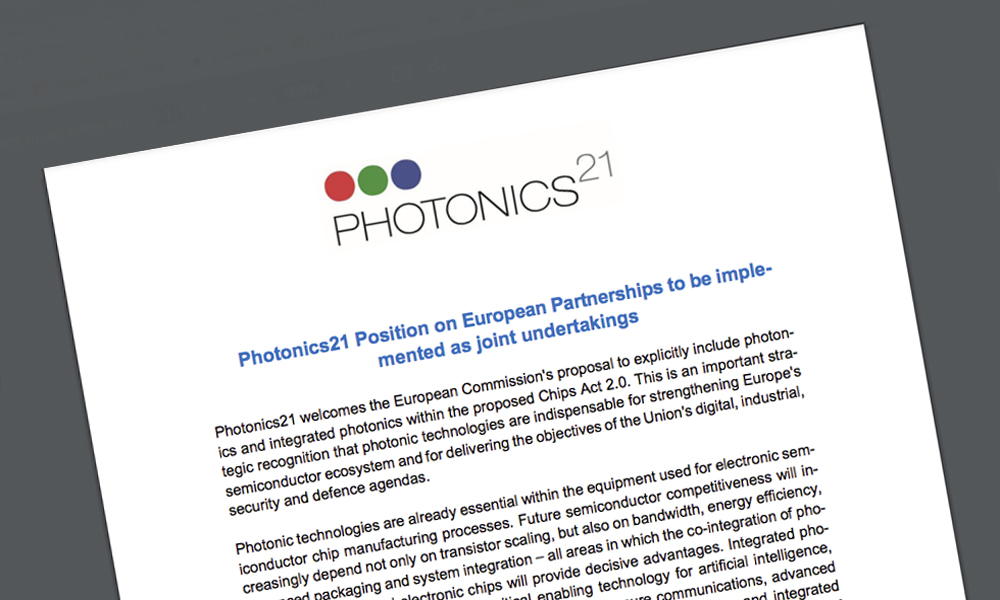
Photonics21 has welcomed the inclusion of photonics in the EC's proposed Chips Act 2.0. Source: Photonics21.
European industry platform Photonics21 has welcomed the inclusion of photonics in the proposed Chips Act 2.0 and issued a call for a dedicated European Photonics Partnership. Photonics21 this week stated on its website: “In the next Multiannual Financial Framework (MFF), some European Partnerships will be implemented as joint undertakings. The European Commission commenced a Call for Evidence, in which Photonics21 participated.”
Photonics21 said that it welcomes the European Commission’s proposal to explicitly include photonics and integrated photonics within the proposed Chips Act 2.0. This is an important strategic recognition that photonic technologies are indispensable for strengthening Europe's semiconductor ecosystem and for delivering the objectives of the Union's digital, industrial, security and defence agendas.
The platform's statement said: “Future semiconductor competitiveness will increasingly depend not only on transistor scaling, but also on bandwidth, energy efficiency, advanced packaging and system integration – all areas in which the co-integration of photonic components and electronic chips will provide decisive advantages.
“Integrated photonic chips are rapidly becoming a critical enabling technology for artificial intelligence, high-performance computing, quantum technologies, secure communications, advanced sensing and next-generation manufacturing. The inclusion of photonics and integrated photonics in the Chips Act 2.0 is therefore fully aligned with Europe's objectives of strengthening technological sovereignty, industrial resilience and global competitiveness.”
Recommendations
Photonics21 recommends a two-track funding architecture for photonics in the next MFF:
- Semiconductor-related photonics and integrated photonics should be fully and explicitly embedded within Chips JU 2.0, benefiting from its funding instruments, infrastructure and governance alongside other semiconductor technologies. This includes: photonic technologies used for the manufacture of electronic semiconductor chips; combinations of photonic components and electronic chips; and integrated photonic chips
- The broader photonics ecosystem spanning biophotonics and medical diagnostics, free space optical communications, laser-based manufacturing and machine vision, agrifood and environmental sensing, mobility and security, defense and quantum communications, computing and sensing, requires a separate, dedicated, ring-fenced budget outside the Chips Act, delivered through an MoU-based Partnership under Horizon Europe and the European Competitiveness Fund.
The Chips Act addresses the semiconductor dimension of photonics. “However,” says the position statement, “photonics is a cross-cutting technology supporting innovation across healthcare, advanced manufacturing, telecommunications, mobility, agriculture, climate technologies, security, defence and quantum technologies. Photonics is one of the few deep-tech sectors where Europe currently excels and is vital to 20% of the EU economy.”
“Maintaining Europe's leadership in photonics requires maintaining leadership across the wider photonics ecosystem, not only integrated photonics. The technologies, manufacturing capabilities, materials, design platforms, pilot lines, packaging technologies and specialised SMEs that enable future photonic integrated circuits are developed through investments across the entire photonics value chain.”
Photonics21 is calling for a “dedicated, ring-fenced budget for photonics research and innovation outside the Chips Act, ensuring sustained support from research and technology development through industrial deployment. This investment should be delivered through a MoU-based Partnership under Horizon Europe and the European Competitiveness Fund.”
Governance and stakeholder representation
The successful implementation of Chips Act 2.0 requires the full participation of Europe's photonics community. Photonics21 is further recommending:
- Formal representation of Photonics21 on the Chips Joint Undertaking Private Members Board, ensuring that the European photonics ecosystem contributes directly to strategic decision-making.
- Systematic involvement of photonics experts in the development of the Electronic Components and Systems Strategic Research and Innovation Agenda, work programmes, proposal evaluations and project monitoring.
- Alignment between the Photonics21 Strategic Research and Innovation Agenda, its Grand Challenges and the Chips Joint Undertaking work programme, ensuring coherence across European investments.
Photonics21 has developed a portfolio of eight Grand Challenge Projects – large-scale, pan-European initiatives that are ready for implementation. Together they provide a concrete investment pipeline capable of translating European research excellence into industrial leadership. Each Grand Challenge represents between €250 million and €900 million of public investment and is expected to leverage at least four times that amount in private investment, creating an overall programme leverage of €6 to €8 billion in industrial R&I.
Photonics21 announces autumn election for new Board of Stakeholders
Photonics21 members are to elect the platform's new Board of Stakeholders between 20th October and 3rd November, 2026. This year, 37 seats are up for election. The organization is inviting members to register now to be able to voter and to nominate a candidate. Important deadlines are as follow:
- Registration as a voter: 21st September 2026 at 17:00 (CET)
- Nomination as a BoS candidate: 21st September 2026 at 17:00
- Online voting period: 20th October 2026 - 3rd November 2026 at noon
The Board of Stakeholders (BoS) is the main decision-making body of Photonics21 and responsible for:
- Determining all matters related to Photonics21
- Defining, pursuing, and implementing the objectives of Photonics21 according to its mission
- Establishing or discontinuing Work Groups and appointing the Work Group Chairs
- Electing the Executive Board, including the President, and appointing or excluding BoS members
- Receiving and approving the annual activity report from the President, including the activities of the Vice Presidents, the Executive Board, the Work Groups, and the Photonics21 Secretariat
- Making all necessary decisions on Photonics21 Membership issues and changing the Terms of Reference
Find more information about the membership and register as a member.


Syntec swings to profit as sales climb
August 19 2026



Hesai goes ‘full-stack’ with extended robotics offering
August 19 2026