



Shanghai-led team develops fiber laser with broad spectrum and low noise
Researchers construct 1.84 m ring cavity with erbium-doped and standard single-mode fibers.
24 November 2026
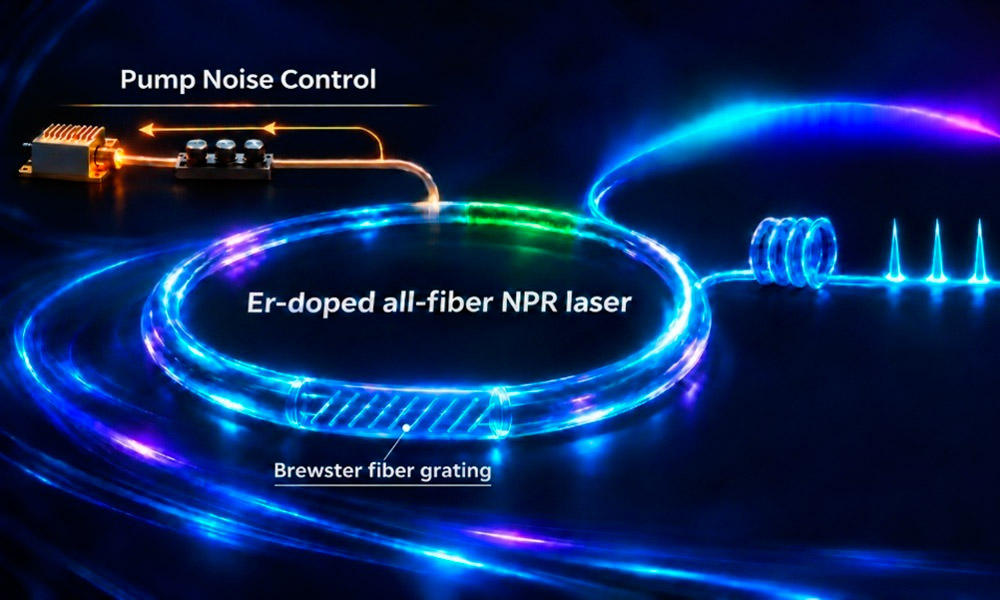
Low-noise, broadband ultrafast fiber laser combines a broad optical spectrum, ultrashort pulses, and exceptionally low noise. Image courtesy of Q. Huang (Shanghai University).
The speed of femtosecond lasers makes them useful for imaging rapid processes, sampling high-frequency signals, and measuring distance or time with high precision. For these applications, a laser must provide not only short pulses and a broad spectrum, but also stable output; fluctuations in pulse intensity or timing can reduce image quality and measurement accuracy.
Researchers in China have now developed an erbium-doped fiber laser that combines a spectral bandwidth greater than 100 nm with pulses shorter than 100 femtoseconds after compression. As reported in Advanced Photonics Nexus, the system also maintains low intensity noise and timing fluctuations. Unlike many broadband ultrafast lasers, it uses an all-fiber design without free-space components that require careful alignment.
“We have successfully developed a broadband, femtosecond mode-locked erbium-doped all-fiber laser with record-low noise by effective cavity management and pump light stabilization,” said Qianqian Huang, the study’s first author.
Broadband fiber lasers have previously generated very short pulses, but many systems rely on free-space elements such as wave plates and diffraction gratings. These components add complexity and can make a laser more sensitive to vibration, temperature changes, and alignment errors. Earlier all-fiber systems offered greater mechanical stability, but they generally could not combine very broad spectra, short pulses, and well-characterized low-noise performance in a single source.
Best of both worlds
The international research team, led by Chengbo Mou of Shanghai University’s Joint International Research Laboratory of Specialty Fiber Optics and Advanced Communication, constructed a 1.84-meter-long ring-shaped laser cavity containing erbium-doped fiber and standard single-mode fiber. Erbium provides optical gain near a wavelength of 1550 nanometers, a region widely used in optical communications and measurement systems. The researchers carefully balanced the dispersion of the two fiber types so that different spectral components of each pulse remained manageable as the pulse circulated through the cavity.
The laser generated pulses through nonlinear polarization rotation. In this process, the polarization of light changes with its intensity as it travels through the fiber. A tilted fiber grating and two polarization controllers selected the most intense portion of the circulating light, supporting the formation of a regular train of short pulses. Because the grating performs its function within the fiber, the system did not require a free-space polarizer.
At a pump power of 528 mW, the laser produced a smooth spectrum centered near 1548 nanometers. Its bandwidth was 100.1 nanometers at half of the maximum spectral power. The pulses initially lasted about 1.6 picoseconds because their spectral components emerged at different times. Passing them through 3.5 meters of additional fiber reduced this delay and compressed the pulses to 72 femtoseconds. The laser operated at approximately 111.78 million pulses per second.
Pulses repeatedly expand and contract
Mou and his team note that this is the first reported all-fiber laser to combine a bandwidth greater than 100 nm with compressed pulses shorter than 100 fs. The researcher team’s numerical simulations reproduced the main experimental measurements, including a simulated bandwidth of 97 nm and a compressed pulse duration of 73 fs. The simulations also showed how the pulses repeatedly expanded and contracted while circulating through the cavity.
The team paid particular attention to fluctuations in the pump diode, which supplies energy to the laser. At lower frequencies, technical noise from this diode can dominate the intensity fluctuations of the output pulses. The researchers stabilized the pump using reflected light from a fiber Bragg grating. By controlling the polarization of the reflected light, they reduced the pump’s intensity noise before it entered the laser cavity.
With the feedback polarization optimized, the laser’s relative intensity noise remained below approximately −143 dB relative to carrier per hertz across measurement frequencies from 100 Hz to 1 MHz. At 10 kHz, the noise fell by about 9 dB as the pump feedback was optimized. The authors report that the measured noise between 100 Hz and 10 kHz is lower than previously reported values for other mode-locked fiber lasers.
The researchers also measured timing jitter, which describes small variations in when each pulse arrives. The integrated jitter was 16 fs between 100 Hz and 1 MHz. Analysis indicated that amplified spontaneous emission, a fundamental source of noise in optical amplifiers and lasers, was the main contributor over much of the measured frequency range. The cavity’s near-zero net dispersion helped limit another important source of timing fluctuations.
To assess longer-term operation, the team monitored the free-running laser for 5.5 hours. Its spectral bandwidth varied by a root-mean-square value of 0.16 percent, while its center wavelength changed by 0.0039 percent. Output power had a root-mean-square variation of 0.43 percent. The remaining fluctuations were attributed mainly to environmental effects on the polarization-sensitive laser cavity.
Mou remarked, “The combination of broad bandwidth, short pulses, and low noise could support high-resolution optical coherence tomography, ultrafast imaging, optical sampling, and photonic analog-to-digital conversion. The all-fiber construction may also make such sources easier to package and operate outside carefully controlled laboratory settings. Further improvements could include active control of the cavity length and pump current, as well as more precise pulse compression to remove residual distortions.”
Samsung and ams Osram agree €210M microLED collaboration
November 25 2026
Avicena raises another $100M to scale microLED links
November 25 2026
University of Maryland spots earlier signs of glaucoma...
November 25 2026
University of Rochester sees bones healing in detail
November 25 2026

White paper outlines opportunities for Swiss photonics sector
November 19 2026