



SPIE O+P 2026: Radiologists discuss rise of AI and need for responsibility in medicine
As patients increasingly turn to AI for medical insights, experts at last week’s San Diego meeting cautioned that clinical judgment still rest with humans.
By By William G. Schulz 02 September 2026
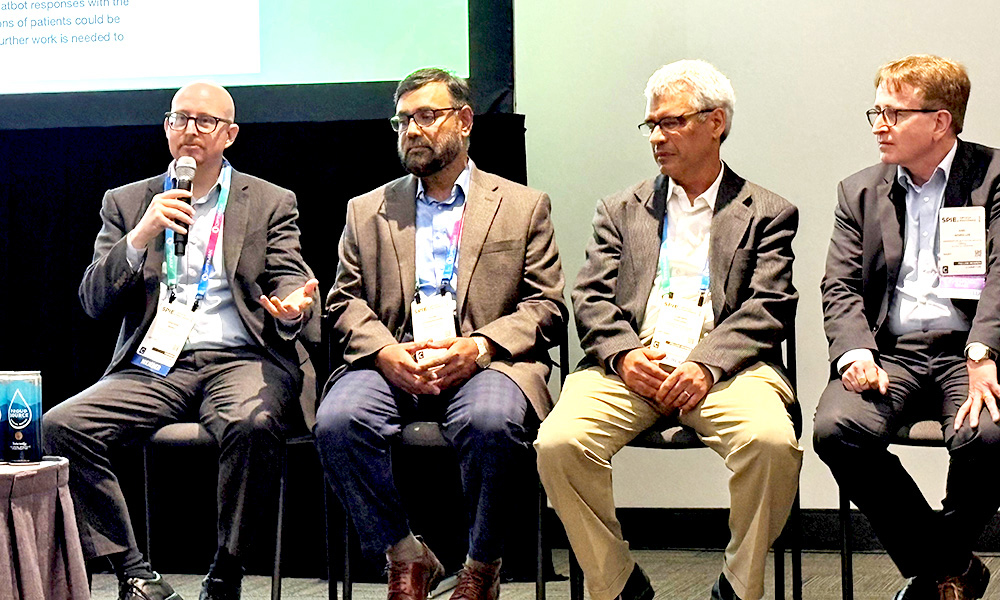
Left to right: Grayson Baird (Brown U), Khan M. Iftekharuddin (Old Dominion U), Lubomir Hadjiiski (U Michigan), and Axel Wismüller (U Rochester Medical Center). Photo: Joey Cobbs / SPIE.
The risks and future of artificial intelligence (AI) in radiology was the topic of a lively biomedical applications panel discussion at SPIE Optics + Photonics, held 23 – 27 August in San Diego, California. Panelists explored the clinical risks, legal liabilities, and technical limitations of integrating large language models (LLMs) into radiology workflows. Despite years of predictions that AI would one day replace radiologists, for now the reality of medical practice shows that AI can be a tool, an assist, but not a replacement for human judgment and deep expert questioning of results.
Nonetheless, the first question posed to the panel took the discussion to a reality that no one in the clinic controls, and that may even lie beyond government regulation: What happens when patients upload their radiology images to a publicly available LLM like ChatGPT or even more specialized services to get an interpretation of medical reports?
Panel moderator, Joana B. Pereira of the Karolinska Institute, noted “AI is being democratized. The access to AI is becoming incredibly wide. There are companies that are making a profit out of this…. It’s something that patients can individually purchase. They can pay $50, upload the scans, and get a full radiological report.”
Panelist Grayson Baird, a psychologist and radiologist at Brown University, noted that in yet-to-be published studies patients seeking an AI generated diagnosis perhaps don’t appreciate the potential for error in publicly available LLMs (or even in LLMs specifically designed for radiology imaging analysis). Yet, they have begun confronting radiologists with results obtained, wanting second opinions, “and then that’s going to have legal consequences [for the radiologists].”
Indeed, other panelists — including Axel Wismüller, University of Rochester Medical Center; Lubomir M. Hadjiiski, University of Michigan; and Khan M. Iftekharuddin, Old Dominion University — noted the rise of publicly available LLMs where patients can upload radiology results and request an opinion. But, in the fine print, all such online services exempt themselves from legal liability. That burden remains with physicians who order, conduct, and interpret the tests.
Wismüller noted that the level of confusion that can be generated by AI analysis of radiological images has been a driver of policy about those results even when they are generated by radiologists themselves from known image archives.
“We keep the AI results protected,” he said of his institution, “so that not everyone outside radiology has immediate access to this because it causes more confusion as it actually provides solutions.”
Iftekharuddin said, “I firmly believe that AI is not ready, especially these models, and not just in this area, [but] many other areas. So, we should be careful. There are very specific areas where we can use tools, where we would like to have sort of a speed, where we would like to help out the human resources. I think those are appropriate.”
Wismüller added, “In situations where there is zero error tolerance, because it’s a situation of life or death, people still have a tendency toward trusting humans more than machines—but that may go away at some point.”
For Iftekharuddin, repetitive tasks, pattern recognition tasks, learning tasks are “where AI will help and can help. That’s where AI will be really a perfect sort of tool to use. The cognition aspect of [AI], it’s not going to happen because that’s an innate characteristic of human beings.”
Hadjiiski commented that, like it or not, “radiologists are using AI because it’s used in the machines that acquire the data. I don’t think there’s any machine like MRI that doesn’t use a lot of AI.” The data processing done by imaging equipment may not be an LLM, he said, but it can be characterized as AI nonetheless.
Of full-on AI radiology report generation, Wismüller predicted that in the next two to three years it will be a starting point. “And then the task is to be the human who validates the correctness of that radiology report draft, step by step. It’s not too much of a difference whether the report draft comes from a radiology resident or an artificial intelligence. For radiologists working in private practice, they will have to change their operating mode from report generation to point-by-point validation.”
In a clinical setting, said Hadjiikski, “you really want to be sure that the code that you are running is doing what you expect it to do, and that someone can actually check, validate, and say, ‘I stand by this code and I take full responsibility.’ I wouldn’t buy any software from a company that says, ‘I give it to you, but I don’t guarantee anything here.’”
William G. Schulz is Editor in Chief of SPIE Photonics Focus.
Invisible tattoos that appear when illuminated
October 15 2026


Xiver picks up €28M debt finance to aid photonic chip production
October 15 2026
U.S. Army Research Office awards $19.2 million to Florida team
October 14 2026
ASML looks to add more capacity as chip boom continues
October 14 2026