


SPIE Optics & Photonics 2026: Nanoscience and engineering plenaries
From organic electrochemical meta-displays to molecular recognition in carbon nanotube nanosensors.
By by Matthew Peach in San Diego 25 August 2026
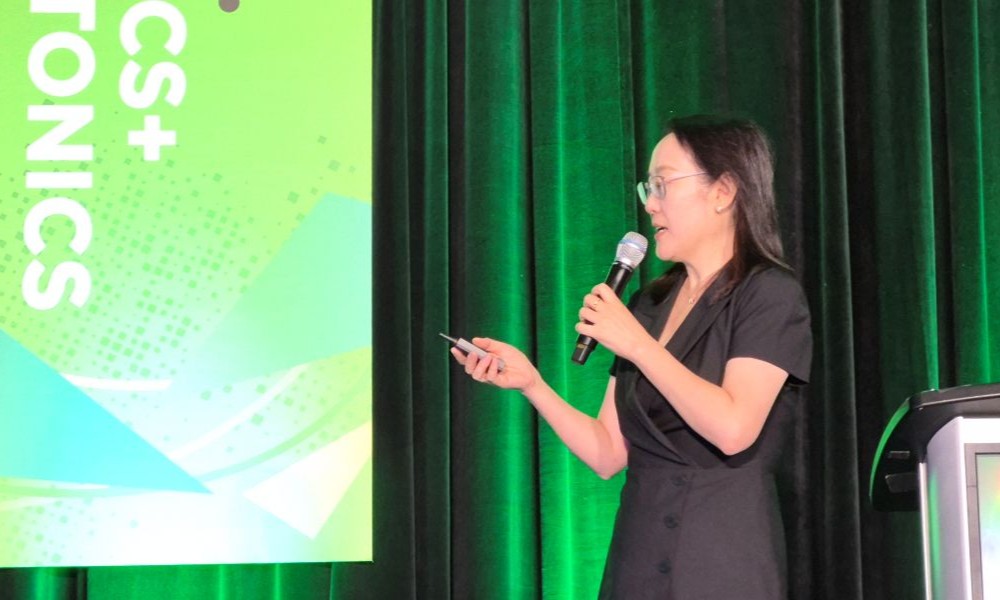
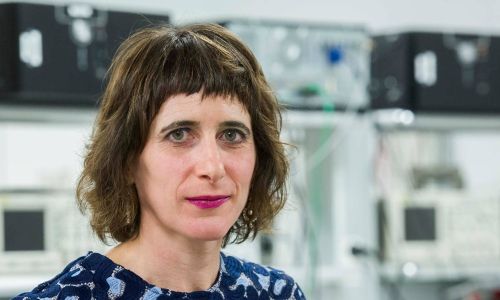
Plenary speaker Prof. Laura Na Liu presented her group’s work on organic electrochemical metasurfaces. Photo: Matthew Peach, optics.org.
Prof. Liu, who received her Ph.D. in Physics from the University of Stuttgart, Germany, has since worked as a postdoctoral fellow at the University of California, Berkeley, then as a Texas Instruments Visiting Professor at Rice University. In 2020, she returned to Stuttgart, where she became the Director of the 2nd Physics Institute.
Further information from Q&A
Following Prof. Liu’s presentation, the Q and A session revealed further technical details and the potential of her group’s emergent display technology. She was asked how much power would be required to switch the pixels on and off; was there any limiting thermal effect; and what was the switching time.
Prof Liu said, “I have made a comparison between liquid crystal-based
She added, “Currently, the switching time is of the order of a millisecond. In the future, if we need to do it faster, there are a lot of things we still need to improve. In fact, for the active polymers, one can achieve a switching time in the order of microseconds. But this requires a lot of polymer synthesis optimization. So, right now, we are still using a
Prof. Liu answered: “At this stage, we cannot replace conventional display technologies. We are still at the stage or proof of concept. There are a lot of technical challenges that we need to face.For example, right now, we are still facing a difficulty to expand
 From single-molecule detection to living plant diagnostics
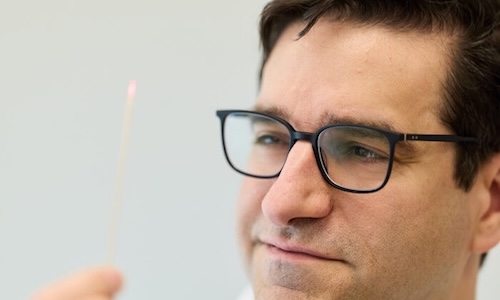
Second plenary presenter Prof. Michael Strano is currently the Carbon P. Dubbs Professor in the Chemical Engineering Department at Massachusetts Institute of Technology (MIT). His research focuses on biomolecule-nanoparticle interactions and the surface chemistry of low dimensional systems, nano-electronics, and applications of vibrational spectroscopy to nanotech.
The plenary presentation was entitled “Exciton-driven optics and molecular recognition in carbon nanotube nanosensors”. In it, Prof. Strano outlined that “fluorescent single-walled carbon nanotubes (SWCNTs) have emerged as uniquely power
By engineering the corona phase surrounding SWCNTs, including DNA, polymers, and aptamer-functionalized coatings, molecular recognition can be programmed without perturbing the nanotube’s intrinsic photophysics. These corona phase molecular recognition (CoPhMoRe) strategies produce highly selective and reversible optical responses to analytes ranging from nitric oxide and hydrogen peroxide to proteins and neurotransmitters.
He said, “These optical nanosensors extract quantitative molecular dynamics from fluorescence trajectories, enabling real-time, label-free measurements of single-molecule adsorption, desorption, and cellular efflux processes.”
Prof. Strano also described advances in optical instrumentation and signal processing, including wavelength-induced frequency filtering (WIFF), which enhances signal-to-noise ratios in highly scattering environments and extends nanosensor imaging to centimeter-scale tissue depths. “These developments have enabled unprecedented applications in living systems, from mapping reactive oxygen species signaling at single-cell resolution to detecting protein secretion from individual microorganisms in real time,” he said.
Applications including real-time imaging of wound-induced hydrogen peroxide waves, multiplexed detection of stress signaling molecules, and direct measurement of plant hormones such as auxin illustrate a new paradigm for precision agriculture.
He concluded, “By enabling continuous, spatially resolved biochemical monitoring in crops, these optical nanosensor platforms open pathways toward early stress diagnostics, climate-resilient agriculture, and next-generation biointegrated
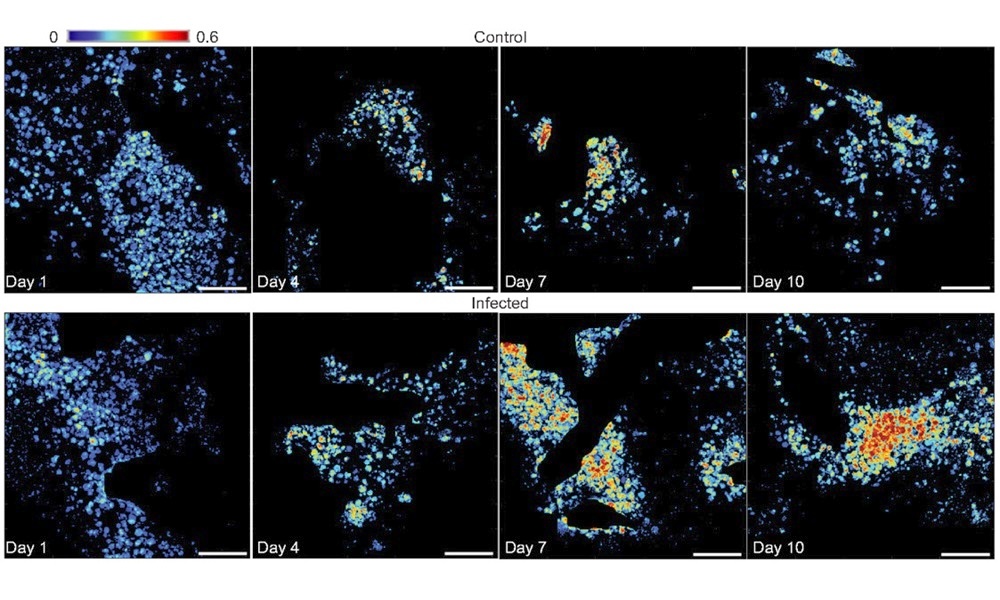
Tufts University observes Herpes virus reshaping neurons
August 26 2026