



UCI Health assesses photodynamic therapy for pancreatic tumors
Initial clinical test of PDT variant suggests possible new treatments.
15 September 2026
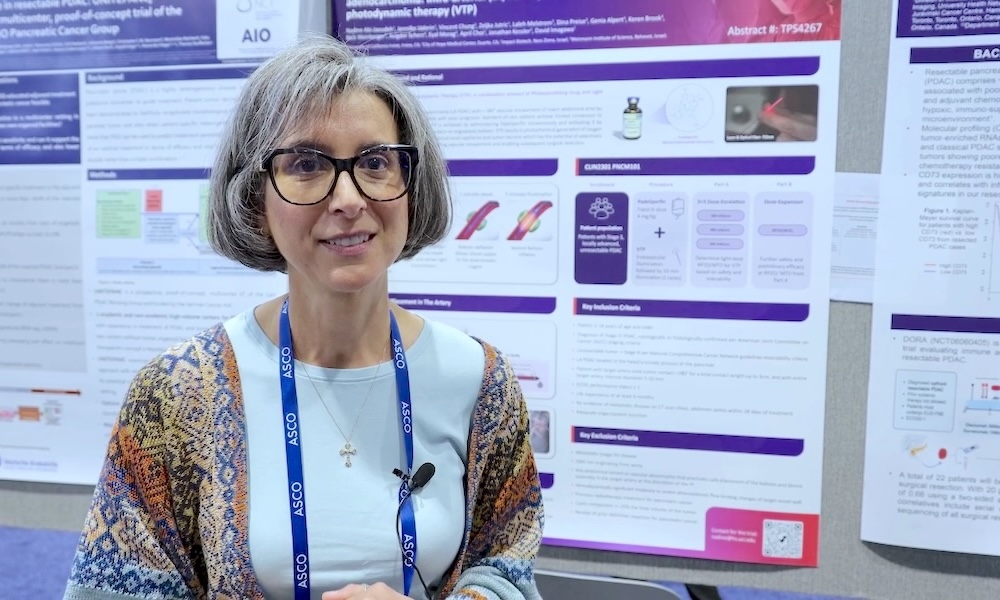
Nadine Abi-Jaoudeh of UCI Health presented the results of the clinical study. Credit: UCI Health online presentation.
A team from the University of California and UCI Health has conducted a first clinical study investigating the application of a form of photodynamic therapy (PDT) to pancreatic cancer, and commenced assessment of the technique as a surgical tool.
Pancreatic cancer has one of the lowest survival rates of all cancers, partly because two-thirds of the patients for whom the cancer has remained localized are still not candidates for surgery. Their tumors are often wrapped around major arteries that deliver blood to the abdomen, and surgery would risk damaging the vessels.
The UCI study, published initially as an abstract in the Journal of Vascular and Interventional Radiology, employed PDT as a localized vascular-directed light-driven way to attack those cancer cells surrounding the vessels, killing them so that surgery can then be carried out. It marks the first in-human phase 1 clinical trial to do so.
PDT involves introducing light-sensitive chemical species into biological systems, inducing them to localize at the point of interest, and then irradiating them with a light source so as to activate their therapeutic behavior. Investigations into using PDT as a cancer therapy have been underway for many years, starting with relatively accessible malignancies such as those in colon cancer.
UCI Health employed vascular targeted photodynamic therapy (VTP), an approach developed by Israeli biotechnology company ImPact Biotech, in which light is applied after intravenous administration of a photosensitizer. This allows the deliberately induced damage to be limited primarily to the local vasculature, causing vessel constriction and blood flow stasis, to starve a tumor of oxygen and nutrients.
VTP treatment was delivered in two five-minute treatments, after participants had received the anti-cancer drug padeliporfin. An intra-arterial optical fiber within a dilation balloon is used to deliver light inside a target artery tangential to the tumor, with the balloon deflated between treatments to allow fresh oxygenated blood into the vessel.
Better options for pancreatic cancer
"First, we inject the patient with a light-sensitive drug," commented team leader Nadine Abi-Jaoudeh. "Then we insert a balloon into the tumor-encased blood vessel. Inside the balloon is a laser. When we turn it on, that activates the drug, killing the tumor surrounding the vessel."
After treatment patients must spend three days in a dark room, because exposure to light could cause damage to other areas like the skin; one reason why this therapy has not been used to treat larger areas, noted UCI Health. Although tissue destruction begins immediately after treatment, the team waited two weeks before surgically assessing the extent of residual tumor tissue and removing it.
For its initial clinical study, UCI Health applied padeliporfin VTP to three patients, and has since given a further three patients the same therapy. Of those six total patients, four had the remaining tumor tissue surgically removed, and three of those patients had no evidence of cancer cells at the surgical margins.
This is a significant finding, because patients with localized cancers who cannot undergo surgery have similarly low survival rates as patients with metastasized pancreatic cancer, noted Nadine Abi-Jaoudeh.
The next steps will be to expand the clinical testing. UCI Health foresees phase 2 and phase 3 trials applying VTP therapy in significantly more patients, after approval by the FDA.
"Once a patient is diagnosed with the inoperable kind of pancreatic cancer, physicians and patients reasonably tend to give up," commented Abi-Jaoudeh. "But there are a lot of solutions being worked on, like this one, to get these patients to surgery and ultimately cancer-free. We are advocating for better options and trying to get the word out to patients."
Theralase study points to cancer breakthrough
April 11 2012
U.S. Army Research Office awards $19.2 million to Florida team
October 14 2026
ASML looks to add more capacity as chip boom continues
October 14 2026

UK’s Salience Labs adds $125M series B
October 14 2026

Francis Halzen awarded Nobel Prize in Physics 2026
October 12 2026