


UCLA conceals targets with structured surfaces
"Lying mirror" turns input image into new misleading pattern.
12 August 2026
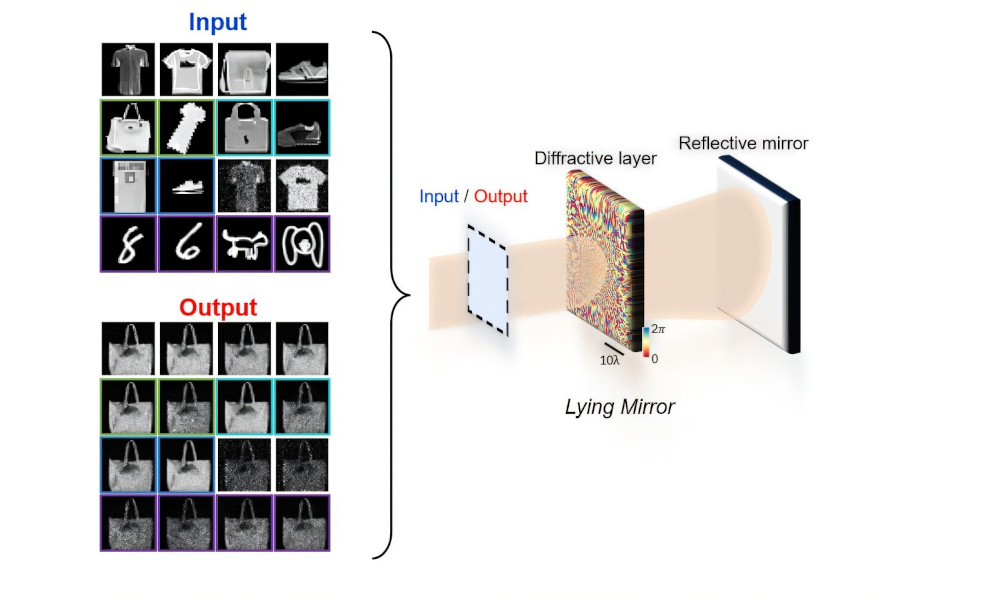
All-optical lying mirror. An optimized diffractive surface and a reflective mirror transform diverse and unknown inputs into predefined, ordinary-looking output patterns, thereby misleading observers. Credit: Ozcan Lab, UCLA.
A project at the University of California, Los Angeles (UCLA) has demonstrated an optical system able to hide input information by transforming it into misleading, ordinary-looking patterns that effectively camouflage the underlying image data.
Published in Nature Communications the principle behind this "lying mirror" could lead to new applications in security, defense, anti-surveillance technologies and entertainment.
The all-optical system combines a reflective mirror with an optimized structured diffractive surface, commented UCLA, so instead of using a computer to digitally alter an image, the lying mirror performs the transformation through programmed light diffraction and passive light-matter interactions.
Once the diffractive surface is designed and fabricated, the optical transformation that hides the input information itself requires no digital computation.
"Instead of simply distorting a reflection, the lying mirror is designed to optically replace the visual information carried by many different unknown inputs with a predefined deceptive pattern," said Aydogan Ozcan from UCLA. "This illustrates how a passive structured surface can perform sophisticated visual information processing directly through structured light matter interactions."
UCLA's design consists of a standard reflective mirror and a trainable diffractive layer of 120 × 120 phase-modulating features, each measuring half of the incident light's wavelength in lateral size. The propagation and programmed diffraction of light by this modulating layer carries out the transformation of light from a target.
Using deep learning, the UCLA team optimized the phase profile of the structured surface so that many different and unknown input objects can be mapped to a predefined dummy misleading output image.
This meant that each lying mirror could be trained with a specific image dataset designed to generate a consistent "dummy" output message, and then reproduce that dummy output for all input variations. Small input images of items including shirts, backpacks and shoes were turned into consistent output images of only bags by the mirror.
Creating visual ambiguity
"Under red, green and blue illumination at 600, 550 and 480 nanometers, randomly selected objects that had not been used during training were successfully transformed into a predefined dummy output image," said UCLA.
The researchers also developed a version of the lying mirror intended for broadband operation and trained across a continuum, extending the concept beyond discrete RGB illumination. This design successfully turned 10 randomly selected images from a standard input data set into a dummy handwritten digit "8,", validating the lying mirror's ability to operate across a range from 500 to 600 nanometers.
The system remained functional when input objects were randomly rotated, shifted or scaled, and when image noise was added, commented UCLA, demonstrating the lying mirror's ability to conceal a broad range of structured inputs rather than simply memorizing a set of input-output pairs.
*Diffractive visual processor-based lying mirrors offer valuable potential across a wide range of fields and have diverse applications, from entertainment and experimental psychology to defense and security," wrote the project. "They can also be used for disorienting adversaries, by altering the perception of space and creating visual ambiguity."
Phase imaging catches sight of obscured objects
July 26 2023



Lumentum stock rises as annual sales top $3BN
August 12 2026