


University of Southampton improves genomic workflows with vibrational spectroscopy
New route to measuring DNA fragments could assist sequencing and medical diagnoses.
19 August 2026
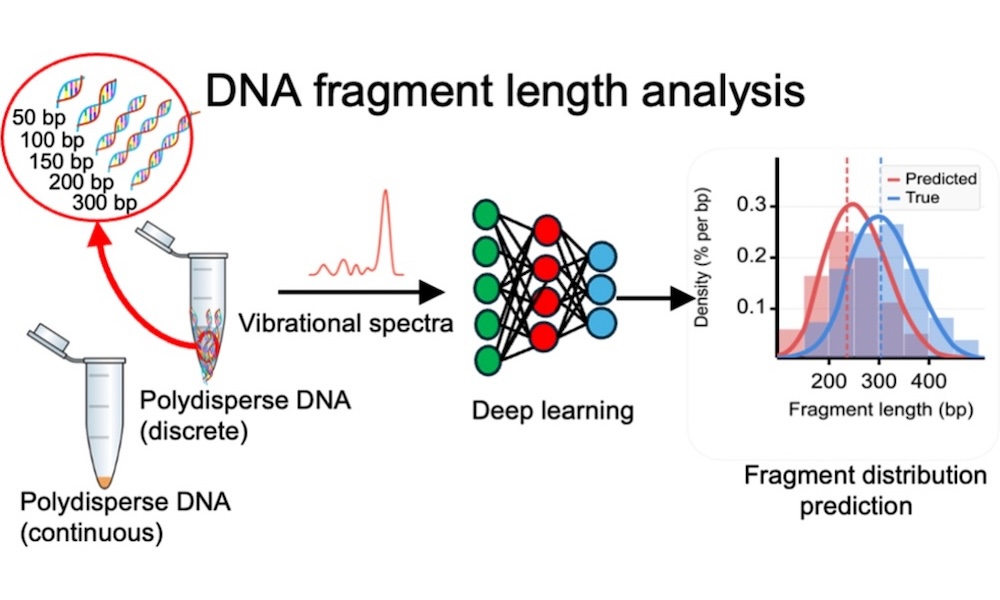
A new approach to DNA analysis. Credit: Optoelectronics Research Centre.
Researchers at the University of Southampton's Optoelectronics Research Centre (ORC) and The Institute of Cancer Research (ICR) have demonstrated a new technique for assessing the length of DNA molecules and fragments.
Described in two papers published in ACS Measurement Science Au, the findings open up a potential new way to analyze genetic material for genomic workflows including next-generation sequencing and fragmentomics-based diagnostics.
DNA fragment length is attracting growing interest as a biomarker in cancer research and an objectively measurable indicator of disease, commented ORC.
Small fragments of DNA released from tumors appear in the bloodstream as circulating tumour DNA (ctDNA), and are typically shorter than those released from healthy cells. Analysing fragment length can help monitor disease progression and assess how patients are responding to treatment.
Measuring DNA fragment length remains technically demanding, however. Gel electrophoresis can physically separate DNA by size, while sequencing-based approaches are often used for analysing ctDNA. But these require specialised equipment, can be expensive and may consume or alter the sample. This limits their accessibility, particularly in lower-resource settings.
The ORC solution, described in the first paper, integrates vibrational spectroscopy with deep-learning data processing for a rapid label-free route to quantifying DNA fragment length distributions. The second paper describes use of the spectroscopy technology to measure DNA methylation, a regulator of gene expression that when disrupted is associated with several human diseases including cancer.
"Light interacts with biological molecules almost instantaneously, producing unique molecular signatures that reveal important information about their structure and composition," commented Senthil Murugan Ganapathy from the ORC. "This study shows that, when combined with AI, vibrational spectroscopy can reveal characteristics of DNA that previously required complex laboratory techniques."
Making genetic analyses faster, cheaper, more accessible
The ORC platform employed Attenuated Total Reflectance-Fourier Transform Infrared (ATR-FTIR) and Raman
spectroscopies. ATR-FTIR is based on use of an optical sensor material with a high index of refraction, so that internal reflection within the sensor takes place and enhances the intensity of the FTIR spectrum ultimately recorded from a target.
In trials, trained machine learning models predicted DNA length from the vibrational spectroscopy data, while a convolutional neural network trained on DNA mixtures of molecules with different lengths successfully recovered their fragment length profile.
"A 1D convolutional neural network trained on augmented spectra from purified DNA mixtures successfully learned fragment-specific spectral representations," noted the project in its paper. "Transfer learning to a small cohort of biological samples with continuous fragment length distributions enabled accurate prediction on independent test samples."
The next steps will include further studies to improve the accuracy of the models, validate the approach against established laboratory methods and determine how it might be integrated into future genomic workflows.
"While the research will not have an immediate impact on patients, it opens up a completely new avenue of investigation," said Stephen-John Sammut from The Institute of Cancer Research. "By showing that spectroscopy and AI can be used to estimate DNA fragment length for the first time, the study lays the groundwork for future technologies that could make important genetic analyses faster, cheaper and more accessible around the world."
Optical processor aids DNA sequencing
February 13 2018
NIST flow cytometry counts cells with certainty
July 27 2022

Hesai goes ‘full-stack’ with extended robotics offering
August 19 2026

Fudan University images tumor boundaries within 30 minutes
August 18 2026